Why Do Urdu and Hindi Speakers Say “Informations”? Countable and Uncountable Noun Rules That Fix It
Why Do Urdu and Hindi Speakers Say "Informations"? Countable and Uncountable Noun Rules That Fix It
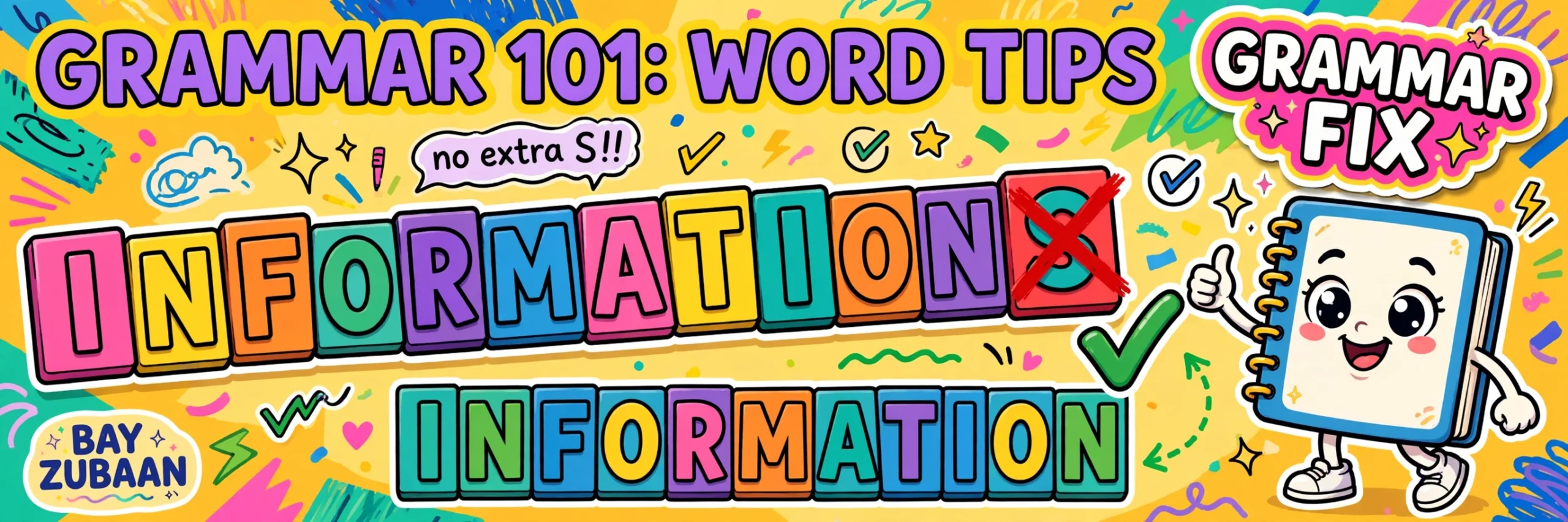
Short answer: In English, nouns like information, advice, furniture and news are uncountable, so they never take "a", "an" or an "-s" plural. In Urdu and Hindi, the same words commonly take plural forms in daily speech (mashware, maloomat), which is why "informations" and "advices" feel natural to translate word for word. The fix is a short list of quantifiers (a piece of, an item of, a bit of) and one habit: checking the [C] or [U] mark in a learner's dictionary.
If you have ever written "I need your advices" in an email or said "Give me two informations about the job", this article is for you. These are not careless mistakes. They come from translating Urdu or Hindi grammar into English, and once you understand why the rule exists, you stop making the error for good.
What is the difference between countable and uncountable nouns?
Short answer: A countable noun names something you can count as separate units: one apple, two apples, three apples. An uncountable noun names something you cannot separate into units: water, rice, advice, information. Countable nouns take "a" or "an" and form plurals; uncountable nouns never take "a" or "an", never take a number, and never add "-s".
Cambridge Grammar Today puts it plainly: some things in English are seen as a whole or mass, and these are called uncountable nouns because they cannot be separated or counted. So you can say "a chair" or "three chairs", but you cannot say "a furniture" or "three furnitures". The noun furniture refers to the whole category of household items as one mass, so the sentence stays singular: "We are going to get new furniture for the living room."
The British Council makes the same point for beginners: nouns can be countable or uncountable, and when you learn a new noun you should check which one it is and note how it is used in a sentence. Its examples are deliberately everyday: "There is a man at the door", "I have some friends in New York", "There is some milk in the fridge", "There is not any coffee". Notice the pattern. Singular countable nouns take "a" or "an". Plural countables and uncountables take "some" in positive sentences and "any" in negatives. A singular countable noun never takes "some" on its own.
A learner's dictionary tells you which is which. Cambridge marks nouns [C] for countable and [U] for uncountable. Make this a habit for the first month and the rule stops being a guessing game.
Why does this rule confuse Urdu and Hindi speakers so much?
Short answer: Because Urdu and Hindi treat many of these words as countable. In everyday Urdu, "mashware" (advices), "maloomat" or "itlaat" (informations) and "akhbaraat" (newspapers) are completely normal plurals. When your first language says a word can be counted, your English brain counts it too.
This is a well documented kind of first-language interference. Cambridge notes that some nouns which are uncountable in English are countable in other languages, and it gives exactly our problem words: accommodation, advice, furniture, information. Cambridge's Liz Walter wrote in the dictionary blog that if she had a pound for every time a student said "an advice" or "some informations", she would be very rich by now. The most common problem words her students produce are equipment, furniture, transport, knowledge, countryside, traffic, research, progress, evidence and machinery. Read that list twice, because it is almost exactly the list of words South Asian learners get wrong.
There is a second, subtler reason. Urdu and Hindi have no articles at all: there is no "a", "an" or "the" in either language. So the whole system of "a/an for one, the for the known one, nothing for uncountables" has no anchor in your mother tongue. You are not just learning a rule; you are learning a category of word that your first language never asked you to notice.
The good news is that the fix is mechanical. English uncountable nouns fall into a few families, and once you learn the families you can guess correctly most of the time.
The four families of uncountable nouns
Short answer: Most uncountable nouns in English belong to one of four groups: ideas and experiences, materials and substances, weather words, or names for collections of things. Learn the groups and you will rarely have to guess.
Cambridge groups uncountable nouns like this:
- Ideas and experiences: advice, information, progress, news, luck, fun, work
- Materials and substances: water, rice, cement, gold, milk, bread, sugar
- Weather words: weather, thunder, lightning, rain, snow
- Names for groups or collections: furniture, equipment, rubbish, luggage
And some common ones that do not fit neatly but still count as uncountable: accommodation, baggage, homework, knowledge, money, permission, research, traffic, travel.
The pattern is physical sense. You can count grains of rice, but "rice" as a substance is a mass. You can count individual chairs, but "furniture" names the whole collection. English treats the mass as one thing, singular, always.
The 12 uncountable nouns Urdu and Hindi speakers get wrong most
Short answer: The repeat offenders are information, advice, furniture, equipment, homework, news, luggage, traffic, knowledge, progress, money and research. Every one of them is uncountable: no "a", no number, no "-s", singular verb.
Here is the correction list. Read the wrong version first, say it out loud, then read the right one. Your ear needs to catch the mistake before your hand does.
1. Information (maloomat, itlaat)
Wrong: "I got many informations about the visa."
Right: "I got a lot of information about the visa."
Memory hook: information behaves like water. You would never say "three waters", so never say "three informations".
2. Advice (mashwara)
Wrong: "He gave me an advice."
Right: "He gave me some advice."
Memory hook: "mashwara" can be singular or plural in Urdu, but "advice" in English is always singular in form.
3. Furniture (farnichar, samaan)
Wrong: "They bought new furnitures for the house."
Right: "They bought new furniture for the house."
Memory hook: furniture is already a collection word, like "samaan". The plural is built into the meaning.
4. Equipment (aalaat)
Wrong: "The gym has modern equipments."
Right: "The gym has modern equipment."
Memory hook: if it comes as a set, English keeps it singular.
5. Homework (homework, ghar ka kaam)
Wrong: "The teacher gave us three homeworks."
Right: "The teacher gave us three homework assignments." or "a lot of homework"
Memory hook: homework is a mass like "work", and work is uncountable too.
6. News (khabrein)
Wrong: "These news are shocking."
Right: "This news is shocking."
Memory hook: news ends in "-s" but behaves as a single story. The verb stays singular: "The news is good."
7. Luggage (samaan, saamaan-e-safar)
Wrong: "My luggages are at the station."
Right: "My luggage is at the station."
Memory hook: one suitcase or ten, the word does not change. "A piece of luggage" means one item.
8. Traffic (trafic, gaariyan)
Wrong: "There were many traffics on the road."
Right: "There was a lot of traffic on the road."
Memory hook: traffic is a flow, not individual cars. Count the cars instead: "There were many cars."
9. Knowledge (ilm, maloomat)
Wrong: "He has good knowledges of history."
Right: "He has good knowledge of history." or "a wide knowledge of"
Memory hook: "ilm" is a mass in Urdu too. Let your Urdu instinct win here.
10. Progress (taraqqi)
Wrong: "You have made great progresses this term."
Right: "You have made great progress this term."
Memory hook: progress is a journey, and journeys do not pluralise.
11. Money (paisa, rupay)
Wrong: "He has many moneys." or the tempting "He has many money."
Right: "He has a lot of money."
Memory hook: count the units, not the word: "many rupees", "many dollars", "a lot of money".
12. Research (tehqeeq)
Wrong: "She published five researches last year."
Right: "She published five research papers." or "She published a lot of research."
Memory hook: research papers are countable; research itself never is.
How do you count something that is uncountable?
Short answer: You count it with a quantifier phrase: a piece of, an item of, a bit of, a loaf of, a bottle of, a grain of. These little phrases turn an uncountable mass into countable units.
Cambridge's rule is that to refer to one or more quantities of an uncountable noun, expressions such as "a bit of", "a piece of", "an item of", or words for containers and measures must be used. The British Council's teaching notes give the classic shopping examples: "one loaf of bread", "one bottle of milk", "a bag of sugar". You cannot say "one bread" or "three milks"; you say "some bread" or use the countable container word.
Here are the combinations worth memorising:
- a piece of advice, a piece of news, a piece of furniture, a piece of cake
- an item of clothing, an item of luggage, an item of news
- a bit of luck, a bit of fun, a bit of bread
- a grain of rice, a grain of truth
- a loaf of bread, a bottle of water, a cup of tea, a glass of milk
- a word of advice (not "an advice")
Notice the pattern: the countable word in front carries the number, and the uncountable noun stays untouched. "Two pieces of advice", "three items of luggage", "four bottles of water". The plural goes on "pieces", "items", "bottles", never on the noun itself.
When can an uncountable noun become countable?
Short answer: Many uncountable nouns switch to countable when they mean a portion, a type, or a single instance: "a coffee" means a cup of coffee, "cheeses" means types of cheese, "a paper" means one newspaper.
This is the advanced layer, and the British Council treats it as a separate lesson because it surprises learners. Substances are usually uncount, but they can also be used as count nouns:
- "I would like a coffee, please." (a cup of coffee)
- "They sell a lot of coffees." (different kinds of coffee)
- "I prefer white wines to red." (different kinds of wine)
- "They had over twenty cheeses." (over twenty types of cheese)
Some nouns carry two meanings, one count and one uncount, and the meaning changes with the grammar:
- "I made a cake this morning." (a whole cake, countable) vs "Do you want some cake?" (a piece of cake, uncountable)
- "Can I have a glass of water?" (the container, countable) vs "I cut myself on some glass." (the material, uncountable)
- "The Times is an excellent paper." (a newspaper, countable) vs "It is made of paper." (the material, uncountable)
- "Is English a difficult language?" (one language, countable) vs "Linguistics is the study of language." (language in general, uncountable)
The rule of thumb: if you mean a portion, a single serving, or a type, the noun can behave as countable. If you mean the substance or the general idea, it stays uncountable. When in doubt, keep it uncountable. Saying "some coffee" is always safe; saying "a coffee" only works in a cafe context.
Much or many? Little or few?
Short answer: Use "many" and "few" with plural countable nouns; use "much" and "little" with uncountable nouns. "How many brothers do you have?" but "How much money do you have?"
This pairing rule is one of the most tested in English exams, and it falls straight out of the countable/uncountable split:
- many / a few / few go with plural countables: "many chairs", "a few books", "few mistakes"
- much / a little / little go with uncountables: "much advice", "a little sugar", "little progress"
So "How much brothers and sisters do you have?" is wrong, and "How many money do you have?" is wrong. The British Council's practice examples drill exactly this: "How many chairs do we need?" against "How much milk have we got?"
One caution for Urdu and Hindi speakers: "a few" and "a little" sound similar but mean different things. "A few" means some, enough (positive feeling): "I have a few friends in Lahore." "Few" without "a" means almost none (negative feeling): "Few people came." The same split applies to "a little" vs "little": "I have a little time" (some time, fine) vs "I have little time" (almost no time, worry).
Practice quiz: countable or uncountable?
Short answer: Ten quick questions. Fix each wrong sentence, then check your answers below.
- I need an information about the bus timings.
- She gave me many advices before the interview.
- The office bought new furnitures last month.
- How much chairs do we need for the party?
- This news are very disturbing.
- He has little patience with slow drivers. (correct or wrong?)
- I would like a coffee, please. (correct or wrong?)
- They had three luggages at the airport.
- We need some informations before we decide.
- She made great progress this year. (correct or wrong?)
Answer key:
- Wrong. "I need some information about the bus timings." Information is uncountable; it takes no "an".
- Wrong. "She gave me a lot of advice before the interview." Advice never takes "-s".
- Wrong. "The office bought new furniture last month." No plural for furniture.
- Wrong. "How many chairs do we need for the party?" Many goes with plural countables.
- Wrong. "This news is very disturbing." News takes a singular verb.
- Correct. Patience is uncountable, so "little" is the right partner.
- Correct. "A coffee" means a cup of coffee; the portion rule allows it.
- Wrong. "They had three pieces of luggage at the airport." Luggage is uncountable.
- Wrong. "We need some information before we decide." Never "informations".
- Correct. Progress is uncountable and stays singular.
If you scored 8 or above, you have the rule. If not, go back to the twelve correction items and read them aloud again.
Frequently asked questions
Why do Urdu speakers say "informations" when native speakers never do?
Because in Urdu, "maloomat" and "itlaat" are normal plural forms used every day. Your brain treats information the way it treats any Urdu noun and adds the English plural. Cambridge notes that nouns which are uncountable in English are often countable in other languages, and information is one of its listed examples. The habit is logical; it is just English that is illogical here.
Is "advices" ever correct in English?
No. Advice is always uncountable in modern English. Say "some advice", "a piece of advice", or "a word of advice". The word "advices" does not appear in standard dictionaries as a plural.
Why is "news" singular when it ends in "-s"?
Because news is short for "new things reported", but English treats it as one mass of reporting. It takes a singular verb: "The news is good", "This news is shocking". Think of it like "mathematics" or "physics", which also end in "-s" but take singular verbs.
Can I say "a bread" or "breads"?
Not for the substance. "Bread" is uncountable: "some bread", "a loaf of bread", "two loaves of bread". "Breads" is only used when you mean different types of bread, as in a bakery that sells "artisan breads". For everyday use, keep it uncountable.
What is the quickest way to check if a noun is countable?
Three checks, in order: can you put a number in front of it ("three furnitures" sounds wrong, so it is uncountable)? Can you put "a" or "an" in front of it ("an advice" sounds wrong, so it is uncountable)? And when in doubt, look the word up in a learner's dictionary and read the [C] or [U] mark. Cambridge marks every noun this way, and one month of checking builds a lifetime habit.
Related reading
- Present Perfect vs Past Simple: The Tense Pair That Trips Up Every Desi Learner
- The 20 Preposition Mistakes Urdu Speakers Make Most
- Discuss About, Revert Back, Enter Into: 10 English Verbs That Need No Preposition
Sources
- Cambridge Dictionary, English Grammar Today: "Nouns: countable and uncountable" (dictionary.cambridge.org)
- Cambridge Dictionary blog: "Countable or uncountable, and why it matters", by Liz Walter (dictionaryblog.cambridge.org)
- British Council LearnEnglish: "Nouns: countable and uncountable" (learnenglish.britishcouncil.org)
- British Council LearnEnglish: "Common problems with count and uncount nouns" (learnenglish.britishcouncil.org)
FAQPage JSON-LD to be added as a Custom HTML block with the five FAQ questions above.