Spanish Verb Conjugator: Present Tense Conjugations in One Click
With more than 500 million native speakers, Spanish opens doors across Latin America, Spain, and growing communities in the United States. But its verbs can feel overwhelming: six forms per tense, stem changes, and irregulars everywhere. This Spanish verb conjugator removes the guesswork. Type any common verb and get the full present-tense table instantly – yo, tú, él/ella/usted, nosotros, vosotros, ellos/ustedes – plus the English meaning and a translated example sentence.
The conjugator
How the Spanish present tense works
Regular Spanish verbs are refreshingly mechanical. Drop the infinitive ending (-ar, -er, or -ir) to get the stem, then add the personal endings:
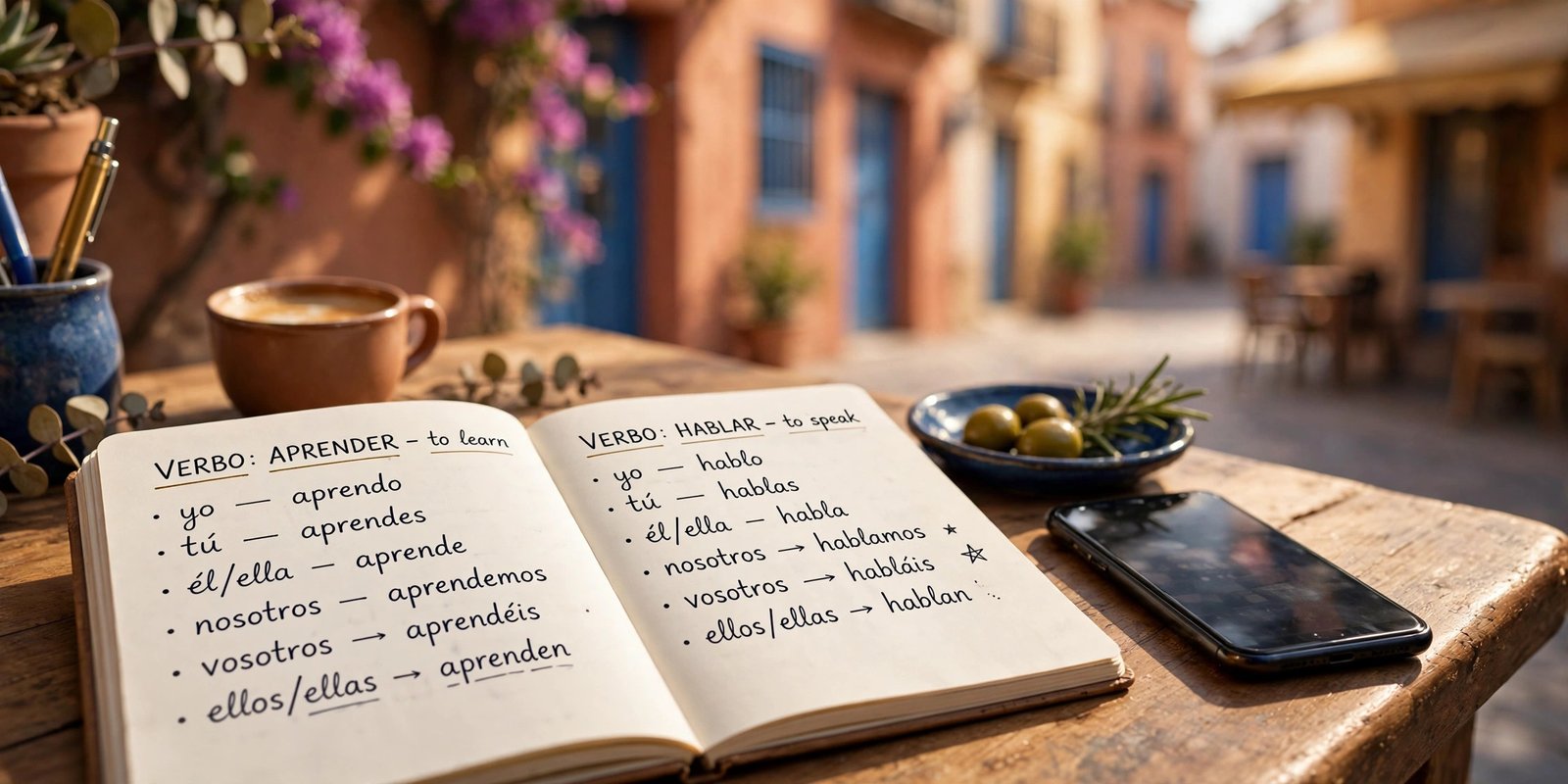
So hablar (to speak) gives yo hablo, tú hablas, él habla, nosotros hablamos, vosotros habláis, ellos hablan. Notice the vosotros forms carry a written accent: habláis, coméis, vivís. Here it is in real sentences: “Los lunes estudio español” (On Mondays I study Spanish). “Hablamos inglés en casa” (We speak English at home). “¿Dónde vives?” (Where do you live?)
The catch is that the most common verbs are the least regular ones. That is why this Spanish verb conjugator has ser, estar, tener, ir, and hacer built in with their correct irregular forms – memorize those first, because you will use them every day.
Stem-changing verbs: the one pattern to watch
A large group of common verbs changes its stem vowel in every form except nosotros and vosotros. There are three patterns:
- e to ie: pensar becomes yo pienso, tú piensas, él piensa (but nosotros pensamos)
- o to ue: volver becomes yo vuelvo, tú vuelves, él vuelve (but nosotros volvemos)
- e to i: pedir becomes yo pido, tú pides, él pide (but nosotros pedimos)
Then there are the “go verbs”, which add a -g- in the yo form only: tengo, pongo, hago, salgo, vengo, digo. Each verb in the conjugator is marked regular or irregular, so you see exactly what you are dealing with.
Tips for memorizing Spanish conjugations
- Learn the three ending sets first. Almost every Spanish verb follows one of them. Once the endings are automatic, you only need to learn the stem of each new verb.
- Drill the ten most common irregulars as vocabulary. ser, estar, tener, ir, hacer, poder, querer, saber, dar, and ver appear in nearly every conversation. Flashcards work better here than rules.
- Always learn verbs in full sentences. “Tengo tres amigos” sticks in memory far better than a lonely “tengo”. The example sentence in each lookup is a ready-made sentence to copy.
- Pair ser and estar deliberately. Ser covers identity, origin, and traits (“Soy médico”, I am a doctor); estar covers location, feelings, and temporary states (“Estoy en casa”, I am at home). Mixing them is the classic beginner giveaway.
- Do not skip vosotros. If you plan to visit Spain, you need it; everywhere else you still need to recognize it. The table above includes it for exactly that reason.
- Saber vs. conocer: both mean “to know”, but saber is for facts (“Sé la respuesta”, I know the answer) while conocer is for people and places (“Conozco Madrid”, I know Madrid).
- Forgetting the written accent: habláis, estáis, coméis. The accent is part of the correct spelling, not optional decoration.
- Overusing subject pronouns: native speakers usually drop yo, tú, and él because the ending already says who. Say “hablo español”, not “yo hablo español”, unless you want emphasis.
- Querer + infinitive means “want to”: “Quiero aprender” (I want to learn). Querer alone just means “to want” a thing.
Spanish verb conjugator FAQ
Does this Spanish verb conjugator cover every Spanish verb?
No – it has 32 of the most common verbs built in, which is deliberate. These are the verbs you will meet constantly in real Spanish. Regular verbs beyond the list follow the exact -ar, -er, -ir ending patterns shown above, and if you type a regular verb that is not in the dictionary, the tool conjugates it automatically with a note.
Why does Spanish have two verbs for “to be”?
Ser describes what something is: identity, origin, profession, traits. Estar describes how or where something is: location, feelings, temporary conditions. “Soy de España” (I am from Spain) uses ser; “Estoy cansado” (I am tired) uses estar. Getting this split right is one of the fastest ways to sound natural.
What about the subjunctive and other tenses?
This tool covers the present indicative only – the tense you need for about 80% of beginner conversation. Master the present first, then the preterite (past) is the natural next step. If you want to see how these verbs fit the bigger grammar picture, our CEFR levels guide shows what grammar belongs at each level.
Should I learn vosotros if I am going to Latin America?
You will rarely need to say it there, but you still need to recognize it when reading or watching Spanish media from Spain. This conjugator includes the vosotros form for every verb, so you can drill it or ignore it as suits your plans. And if German is on your list too, try our German verb conjugator – it works the same way.
This Spanish verb conjugator is a learning aid covering the present indicative. Irregular forms were checked against standard reference conjugations; for verbs outside the built-in dictionary, always confirm irregular forms with the official RAE dictionary before using them in exams or formal writing.