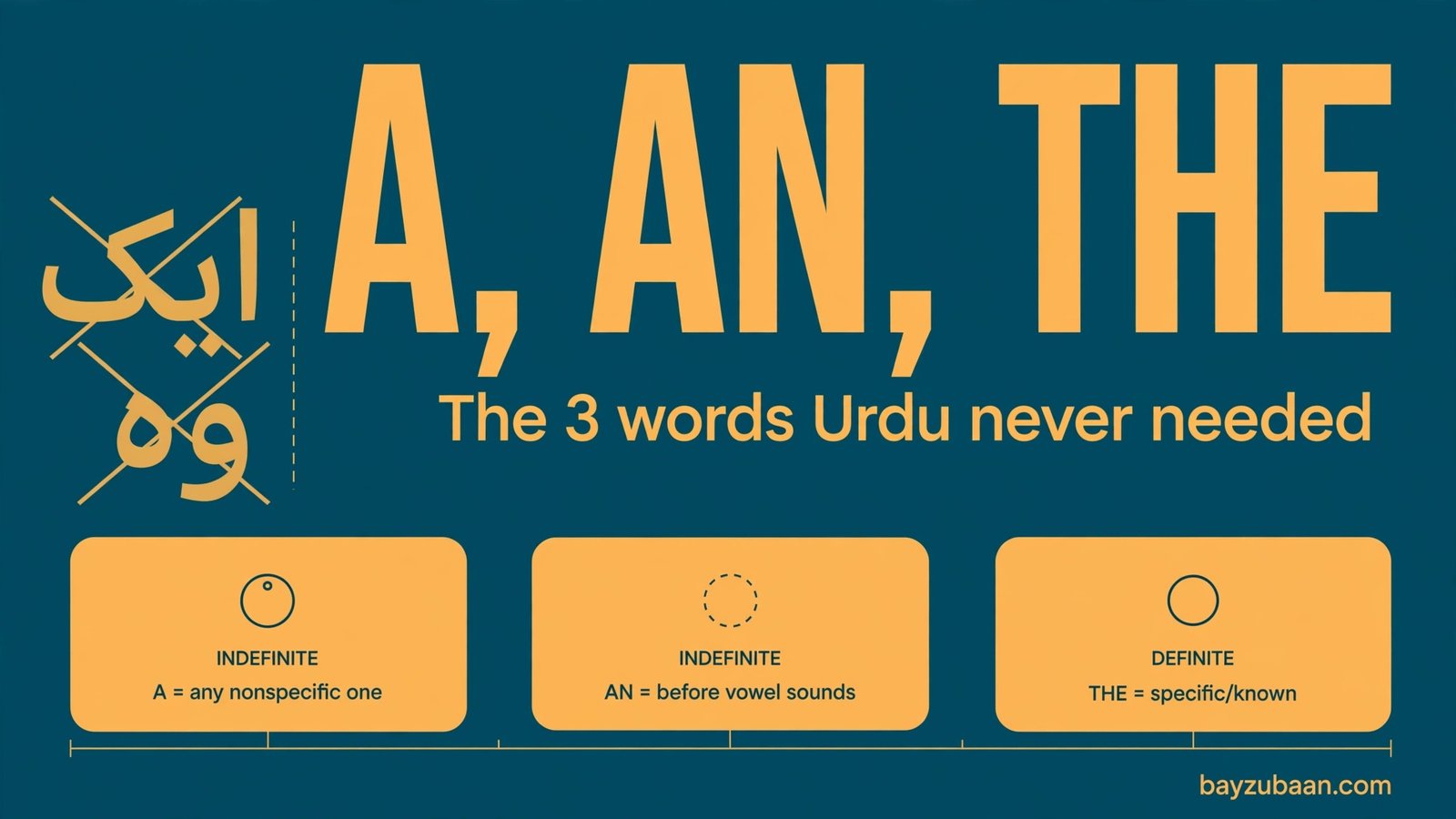
A, An, The: Why Urdu and Hindi Speakers Get Articles Wrong (and the Rules That Fix It)
A, An, The: Why Urdu and Hindi Speakers Get Articles Wrong (and the Rules That Fix It)
If English articles still confuse you after years of study, it is not your fault. It is your first language’s. Urdu and Hindi simply do not have an article system like English, so your brain never learned the distinction that a, an and the demand. Studies of Urdu-speaking learners have found article errors to be among their most persistent mistakes in both writing and speech. The good news: the whole system runs on three rules. Once you understand the why behind them, articles start to feel natural.
The short answer: Urdu and Hindi speakers struggle with articles because neither language marks nouns with an equivalent of a, an or the. Urdu signals definiteness through word order and context, with the word ek working only as a rough stand-in for a or an. Hindi lacks a definite article altogether and uses no article where English would use the. Learners therefore translate from a system with no articles into one where almost every singular noun needs one, which produces the classic pattern of dropping articles or choosing the wrong one.
What are articles in English grammar?
Articles are small words that sit before nouns and tell the listener whether you mean something specific or something general. English has three of them, plus a fourth invisible one:
- The definite article: the, for something specific that both speaker and listener can identify. The book on the table.
- The indefinite articles: a and an, for one thing out of many, not a particular one. A book, any book.
- The zero article, no article at all, used for general statements. Books are useful.
The British Council’s grammar reference puts it plainly: singular countable nouns in English almost always need an article (or another determiner such as my or this) in front of them. That single fact explains half of all article mistakes made by Urdu and Hindi speakers, because their first languages let bare nouns stand alone.
When do you use a or an?
The quotable rule: it is the sound that decides, not the letter. Use a before a consonant sound and an before a vowel sound. The British Council gives the classic pair that proves it: a university (the u sounds like “yoo”, a consonant sound) and an hour (the h is silent, so the word starts with a vowel sound).
More examples to train your ear:
- a book, a car, a European country (sounds like “yoo”), a one-way street (sounds like “wun”)
- an apple, an egg, an honest man (silent h), an MBA (sounds like “em”)
Use a or an when you mention something for the first time, or when it is one member of a group rather than a specific one. I saw a good film yesterday. Do you want a drink? And when you state someone’s job, English almost always uses a or an: He is an architect. She is a scientist. This is the rule behind the most common beginner error of all, “He is doctor”, which we will fix below.
When do you use the?
The quotable rule: use the when you and your listener both know exactly which thing you mean. That shared knowledge comes from three places:
- It was mentioned before. I saw a film. The film was brilliant. First mention gets a; the second mention gets the, because now both of you know which film.
- There is only one of it. The sun, the moon, the internet, the Prime Minister.
- It is made specific by what follows. Superlatives and ordinals take the: the best student, the first chapter. So do phrases that pin the noun down: the book on the table, the school next to the bridge.
For particular groups, use the as well. The British Council contrasts kangaroos (the animals in general) with the kangaroos (the particular kangaroos in that zoo). That contrast is the whole game: general means no article, particular means the.
When do you use no article at all?
The quotable rule: talking about things in general? Drop the article. When you speak about plural or uncountable nouns in a general sense, English uses the zero article:
- Birds eat worms. (birds in general)
- Water freezes at 0°C. (water in general)
- Children need a lot of sleep. (children in general)
- Honesty is the best policy. (honesty in general, not the honesty)
This is the exact spot where research says Urdu-speaking learners stumble hardest. A PhD study published in the Kashmir Journal of Language Research found that learners tend to omit the where it is needed and add it where English wants no article, with general contexts the most difficult area of all. A separate thesis tracking 41 Urdu-speaking undergraduates over two years likewise found article errors the most persistent problem in their writing and speech, with unnecessary the before general nouns a recurring pattern. The takeaway is practical: when you feel the urge to write the before an abstract or general noun, stop and check whether you mean things in general. If you do, leave it out.
Why do Urdu and Hindi speakers get articles wrong?
The cause is structural, not carelessness. English encodes definiteness (specific versus general) directly into little words before the noun. Urdu and Hindi encode it differently: through word order, context, and demonstratives such as yeh (this) and voh (that). The KJLR study notes that Urdu has no definite article at all, and that ek functions only as a quasi indefinite article, so Urdu learners must remap the entire idea of definiteness onto the unfamiliar word the. For Hindi, a University of Pennsylvania linguistics paper on definiteness in Hindi shows the same gap: Hindi lacks a definite article and typically uses no article where English requires the, while its ek behaves differently from English a or an.
An error analysis of Pakistani EFL learners published in the International Journal of Social Science Bulletin (2025) found grammatical errors made up 40.2 percent of all errors identified, with articles, tenses and prepositions among the most frequent, and traced them to learners unconsciously applying Urdu grammatical patterns to English sentences. In other words, your brain is running Urdu software on English hardware. The fix is to install the three rules below until they run automatically.
The 5 classic article mistakes (and the fix for each)
Mistake 1: Dropping the article entirely
Wrong: He is doctor. Right: He is a doctor.
In Urdu, “Woh doctor hai” needs nothing before doctor. In English, a singular countable noun cannot stand alone. Jobs always take a or an: an architect, a teacher, a scientist.
Mistake 2: Using the on first mention
Wrong: She is the doctor. (when introducing her) Right: She is a doctor.
The tells the listener “you know which one I mean.” On first mention, they do not. First mention is a or an; the arrives on the second mention.
Mistake 3: Adding the to general ideas
Wrong: The honesty is the best policy. Right: Honesty is the best policy.
Abstract and general nouns take no article: life is short, education matters, dogs are loyal. This is the error the research flags as the hardest to shake, so give it extra attention.
Mistake 4: Choosing a or an by letter instead of sound
Wrong: a hour, an university. Right: an hour, a university.
Say the word aloud. Hour starts with a vowel sound (the h is silent), so it takes an. University starts with a “yoo” consonant sound, so it takes a. Your ears already know this rule; trust them.
Mistake 5: Forgetting the on second mention
Wrong: I bought a car. Car is red. Right: I bought a car. The car is red.
Once the noun is known to the listener, a must upgrade to the. Think of it as a tiny promotion ceremony: first appearance gets a, every appearance after that gets the.
The 10-second article test
Stuck on a noun? Ask three questions in order:
- Is it plural or uncountable, and do I mean it in general? Yes: use no article. Dogs are loyal. Water is precious.
- Is this the first time I am mentioning this singular thing? Yes: use a or an. I met a teacher.
- Do my listener and I both know exactly which one I mean? Yes: use the. The teacher gave us homework.
Run every uncertain noun through those three questions for a week. Most learners find the habit becomes automatic within days, because the questions mirror exactly how native speakers decide.
Practise: fill in a, an, the, or nothing
- ___ honest man always speaks ___ truth.
- She is ___ engineer at ___ multinational company.
- ___ sun rises in ___ east.
- I need ___ umbrella; it is raining outside ___ house.
- ___ education is ___ key to success.
- He ordered ___ pizza and ___ garlic bread. ___ pizza was delicious.
- She has ___ university degree in ___ economics.
- ___ dogs in our street bark all night. (the particular dogs)
- Dogs are ___ loyal animals. (dogs in general)
- It took me ___ hour to finish ___ homework.
Answers: 1. An, the 2. an, a 3. The, the 4. an, the 5. no article, the 6. a, no article, The 7. a, no article 8. The 9. no article 10. an, the
Frequently asked questions
When do we use a or an in English?
Use a before a word that begins with a consonant sound and an before a word that begins with a vowel sound: a book, an apple, a university, an hour. Use them when mentioning something for the first time or when it is one of many rather than a specific one.
When do we use the in English?
Use the when both you and your listener know exactly which thing you mean: it was mentioned before, there is only one of it (the sun), or it is made specific by a phrase or superlative (the best, the book on the table).
Why is it “an hour” but “a university”?
Because the rule follows pronunciation, not spelling. Hour is pronounced without the h, so it starts with a vowel sound and takes an. University is pronounced “yoo-niversity”, starting with a consonant sound, so it takes a.
Can we use the with plural nouns?
Yes, when the plural noun is specific: the books on the table (those particular books) versus books are useful (books in general, no article). The same general-versus-specific logic applies to plurals.
Why do Urdu speakers overuse “the”?
Research on Urdu-speaking learners finds they both omit the where English needs it and insert it where English uses no article, especially before general nouns. Because Urdu has no definite article, learners have no native instinct for where the belongs and tend to add it for emphasis or safety. Checking whether you mean something general (no article) or specific (the) breaks the habit.
Is “I am student” wrong?
Yes. In English, singular countable nouns need an article or another determiner: I am a student. Saying I am student is a direct translation from Urdu, where “Main student hoon” needs no article. Add a or an and the sentence is correct.
Sources
- British Council LearnEnglish, Articles: ‘a’, ‘an’, ‘the’, the grammar reference for the rules and examples used in this guide.
- Kashmir Journal of Language Research, PhD research on article use by Urdu-speaking learners of English, including findings on omission and overuse of the.
- Analyzing L1 Influence on the Acquisition of English Articles by Urdu Speakers: thesis based on 41 undergraduates, finding article errors the most persistent problem in writing and speech.
- International Journal of Social Science Bulletin (2025): From Urdu to English: A Study of Error Analysis in the Writings of Pakistani EFL Learners.
- University of Pennsylvania linguistics paper on definiteness and information status in Hindi.
Bayzubaan helps Urdu and Hindi speakers master English, one rule at a time. Share this guide with a friend who still says “He is doctor.”