30 Basic Urdu Phrases Every English Speaker Should Know (Greetings to Goodbyes)
Learning basic Urdu phrases for beginners is one of the fastest ways to earn goodwill in Pakistan and among Urdu speaking communities anywhere in the world. You do not need grammar, a textbook, or perfect pronunciation. What you need is a small bank of polite phrases you can say clearly, so you can greet people, thank them, ask for directions, order food, and say goodbye without mangling a single word.
The 30 most useful basic Urdu phrases for a beginner are: Assalam-o-Alaikum (hello), Wa Alaikum Assalam (hello in reply), Aap kaise hain (how are you), Mera naam (my name is), Shukriya (thank you), Maaf kijiye (sorry), Kahan hai (where is), Kitne ka hai (how much), and Khuda Hafiz (goodbye), plus polite words for water, food, directions, shopping, and emergencies. Say them slowly, smile, and native speakers will meet you halfway.
Every phrase below is written in Urdu script, followed by a beginner friendly transliteration in brackets, and a one line note on when to use it. The transliterations are simplified for English speakers and checked against university Urdu courses, so what you read is what you can say.
Greetings: say hello like a local
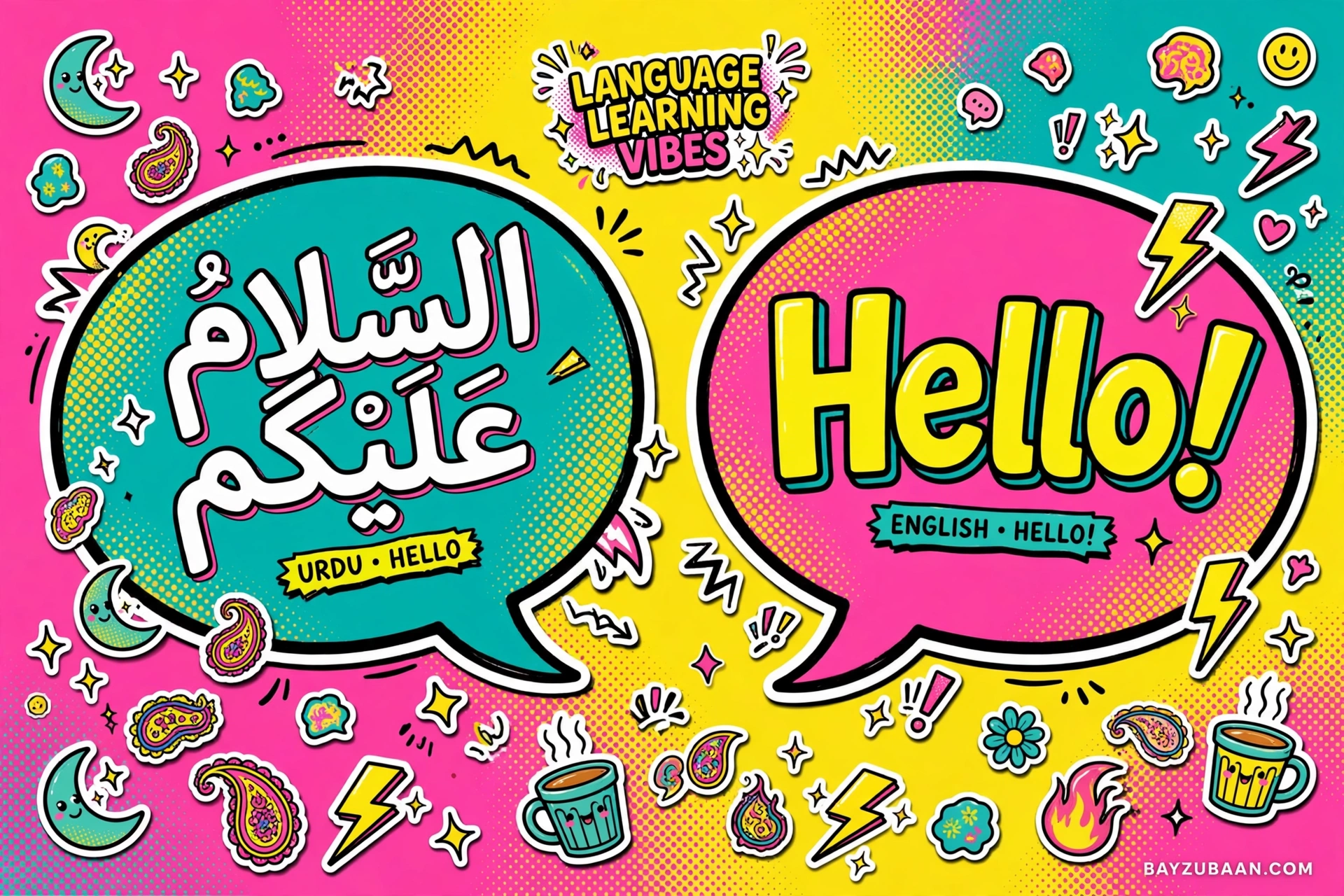
1. السلام علیکم (as-salāmu alaykum)
The universal greeting across Pakistan and the wider Urdu speaking world. It means “peace be upon you” and is the safest, most respectful way to open any conversation. The Michigan State University Urdu course lists it as the standard formal greeting, and the Preply greetings guide calls it the most commonly used greeting in Pakistan. You can use it at any time of day, with anyone, in any setting.
2. وعلیکم السلام (wa alaykum as-salām)
The correct reply when someone greets you with Assalam-o-Alaikum. It means “and peace be upon you too.” Always return a greeting if you can; leaving one unanswered feels abrupt.
3. سلام (salām)
A shorter, casual version of the greeting above. Use it with friends, shopkeepers you already know, or anyone your own age in a relaxed setting. Keep the full Assalam-o-Alaikum for elders and first meetings.
4. آپ کیسے ہیں؟ (āp kaisē hain?)
“How are you?” in formal Urdu. If you are speaking to a woman, the ending changes: آپ کیسی ہیں؟ (āp kaisī hain?). Urdu marks the gender of the person being addressed, so this small change matters. In informal settings with friends you will hear کیا حال ہے؟ (kya haal hai?), which the MSU textbook lists as the informal “how are you.”
Introductions: telling people who you are
5. میرا نام … ہے (mērā nām … hai)
“My name is …” Just drop your name into the gap. Say it slowly, and people will remember it.
6. آپ کا نام کیا ہے؟ (āp kā nām kya hai?)
“What is your name?” Asking this back after giving your own name is the simplest way to keep a first conversation moving.
7. میں … سے ہوں (maĩ … sē hū̃)
“I am from …” Say, for example, main London se hoon (میں لندن سے ہوں). The Preply introductions guide uses this exact structure for towns and countries, so it works for a city or a whole nation.
8. آپ سے مل کر خوشی ہوئی (āp sē mil kar khushī huī)
“Nice to meet you.” Say it with a small nod, especially when introduced to an elder or a host family. It adds real warmth after the name exchange.
9. کیا آپ انگریزی بولتے ہیں؟ (kya āp angrezī boltē hain?)
“Do you speak English?” An honest escape hatch when your Urdu runs out. Many people in Pakistani cities speak English, but asking in Urdu first shows respect and almost always gets a friendlier answer.
Being polite: the phrases that open doors
10. شکریہ (shukriya)
“Thank you.” The single most useful word on this page. Use it constantly, with eye contact and a smile.
11. بہت شکریہ (bohat shukriya)
“Thank you very much.” For meals, gifts, lifts, and any help that took someone time.
12. معاف کیجیے (maaf kījiye)
“Sorry” or “excuse me.” Use it when bumping into someone, when you need to interrupt, or when you want a stranger’s attention before asking a question. For a lighter apology, the Preply guide lists معذرت (maazrat) as an alternative.
13. براہ مہربانی (barāh-e-mehrbānī)
“Please.” It literally carries the sense of “with kindness.” Attach it to any request and your Urdu instantly sounds polite rather than demanding.
14. جی ہاں / جی نہیں (jī hā̃ / jī nahī̃)
“Yes” / “No,” in polite form. The word ji adds a respectful tone, which is why you will hear shopkeepers and waiters say it to you constantly.
Getting around: finding your way
15. … کہاں ہے؟ (… kahān hai?)
“Where is …?” Fill in the place you need: railway station kahan hai? The English words for station, hotel, taxi, and hospital are widely understood, so combine them with this one question frame and you can navigate most of a city.
16. دائیں، بائیں، سیدھا (dāẽ, bāẽ, sīdhā)
“Right, left, straight.” These three words let you follow almost any spoken direction in Pakistan. If someone points and says sīdhā jain, just keep walking straight.
17. کتنا دور ہے؟ (kitnā dūr hai?)
“How far is it?” A smart question before accepting a taxi or a rickshaw, and before setting off on foot. The answer tells you whether to bargain, walk, or find another ride.
18. کیا آپ راستہ بتا سکتے ہیں؟ (kya āp rasta bata saktē hain?)
“Can you show me the way?” People in Pakistan are famously generous with directions, and asking with this full sentence usually earns you a detailed, eager answer rather than a wave.
Eating and drinking: ordering with confidence
19. مجھے پانی چاہیے (mujhē pānī chāhiye)
“I need water” or “I would like water.” Useful in restaurants, homes, and shops. Note that tap water and bottled water are often different prices, so clarify which one you want if it matters.
20. مجھے یہ لا دیں (mujhē yē lā dē̃)
“Please bring me this.” Point at the item on the menu or the dish on another table and say this sentence. It works in any restaurant, dhaba, or street food stall.
21. بل دے دیں (bil dē dē̃)
“Please bring the bill.” The English word “bill” is standard in Pakistani restaurants, so you only need to learn the three Urdu words around it.
22. کھانا بہت لذیذ ہے (khānā bohat lazeez hai)
“The food is very delicious.” Say it to your host or the cook, and watch their face light up. Complimenting the food is one of the surest ways to be invited back.
Shopping and money: bargaining politely
23. یہ کتنے کا ہے؟ (yē kitnē kā hai?)
“How much is this?” The essential bazaar question. Point at the item and ask. If the item is feminine in Urdu grammar, vendors may say kitne ki, but your version will be understood everywhere.
24. یہ بہت مہنگا ہے (yē bohat mehengā hai)
“This is very expensive.” Say it gently with a smile after hearing the price. It signals that you would like a better offer without turning the conversation sour.
25. سستا کر دیں (sastā kar dē̃)
“Please lower the price.” Bargaining is expected in bazaars and with rickshaw drivers. Ask politely, accept the give and take, and never walk away angry if the price does not move.
26. بل کہاں ہے؟ (bil kahān hai?)
“Where is the bill?” Useful in shops and markets when you are ready to pay and the shopkeeper is busy with someone else.
Emergencies: phrases to keep in reserve
27. مدد کریں (madad karē̃)
“Help!” Short, urgent, and universally understood. Say it loudly and people will come to you.
28. مجھے دوائی چاہیے (mujhē dawāi chāhiye)
“I need medicine.” Useful at a pharmacy. Both دوا (dawa) and دوائی (dawai) are used for “medicine,” so either form works.
Goodbyes: leaving well
29. خدا حافظ / اللہ حافظ (khudā hāfiz / allāh hāfiz)
“Goodbye.” It means “may God be your guardian.” Both versions are standard; Allah Hafiz is common in Pakistan. Use it warmly whenever you part ways.
30. پھر ملیں گے (phir milē̃gē)
“See you again.” A friendly follow up to Khuda Hafiz when you genuinely expect to meet the person again.
Pronunciation quick guide: the sounds English speakers get wrong
Urdu pronunciation is friendlier than it looks, but four features trip up English speakers. The Preply travel phrases guide confirms that stress normally falls on the last syllable of a word, and these tips will fix the rest.
Retroflex t and d. The letters ٹ and ڈ are pronounced with the tongue curled back against the roof of the mouth. The Northwestern University Urdu pronunciation guide describes them as retroflex, like the t in cotton when said quickly with a curled tongue, and distinct from the soft dental ت and د, which are made with the tongue touching the teeth. If kitne sounds flat, curl the tongue.
The qaaf (ق). This letter is pronounced by closing the very back of the throat, further back than an English k, as the University of North Carolina Urdu Alphabet project explains. It is a different sound from the ordinary k (ک), and it appears in common words like قریب (qarīb, near) and وقت (waqt, time). Do not merge it with k; keep it deep.
The nasal n (ں). The nasal marker lets air pass through the nose on the vowel before it, with no separate n sound at the end. You will meet it in ہوں (hū̃, I am) and ملیں گے (milē̃gē, we will meet). Hum the vowel through your nose rather than adding an n.
The kh sound (خ). This is the throaty kh, like the ch in German “Bach,” confirmed by both the Preply pronunciation tips and the Northwestern guide. It appears in خوش (khush, happy) and بخیر (bakhair, good morning). Practise by clearing your throat gently while saying k.
Long vowels. Urdu vowels marked long (ā, ī, ū) are held about twice as long as short ones. Mērā (my) and mera would not mean the same thing if you rushed them, so stretch the marked vowels.
Say every phrase in this article slowly, stress the last syllable, and you will be understood even when the tricky sounds are not perfect. Effort is the politeness.
Frequently asked questions
What are the most basic Urdu phrases for beginners to learn first?
Start with Assalam-o-Alaikum (hello), Shukriya (thank you), Maaf kijiye (sorry), Ji haan and Ji nahi (yes and no), and Khuda Hafiz (goodbye). These five handle greetings, politeness, and farewells, and every other phrase in this guide builds on them.
Is Urdu hard for English speakers to learn?
Urdu has sounds that do not exist in English, such as the retroflex t and d and the throaty qaaf, but its sentence patterns are regular and its polite phrases are short. Most beginners can hold a basic polite conversation after learning a small phrase bank like the one above. Urdu and Hindi share a large colloquial vocabulary, so these phrases are useful on both sides of the border.
How do you say hello politely in Urdu?
Say Assalam-o-Alaikum (السلام علیکم), which means “peace be upon you.” It works at any time of day with anyone, and it is the most commonly used greeting in Pakistan. Reply to it with Wa Alaikum Assalam (وعلیکم السلام), meaning “and peace be upon you too.”
How do you ask how much something costs in Urdu?
Say یہ کتنے کا ہے؟ (yē kitnē kā hai?), which means “how much is this?” Point at the item, ask with a smile, and follow with سستا کر دیں (sastā kar dē̃, please lower the price) if you want to bargain politely.
What is the difference between Khuda Hafiz and Allah Hafiz?
Both mean goodbye, literally “may God be your guardian,” and both are standard Urdu. Allah Hafiz (اللہ حافظ) is very common in Pakistan, while Khuda Hafiz (خدا حافظ) is heard across the wider Urdu speaking world. Either one is correct and warm.
Your first conversation
You now have everything you need for a first Urdu conversation from start to finish. Open with Assalam-o-Alaikum, say mera naam and your name, ask aap ka naam kya hai, thank people with shukriya, order with mujhe ye laa dein, pay with yeh kitne ka hai, and close with Khuda Hafiz. Thirty phrases, one polite traveller, and a whole new set of people delighted that you tried.