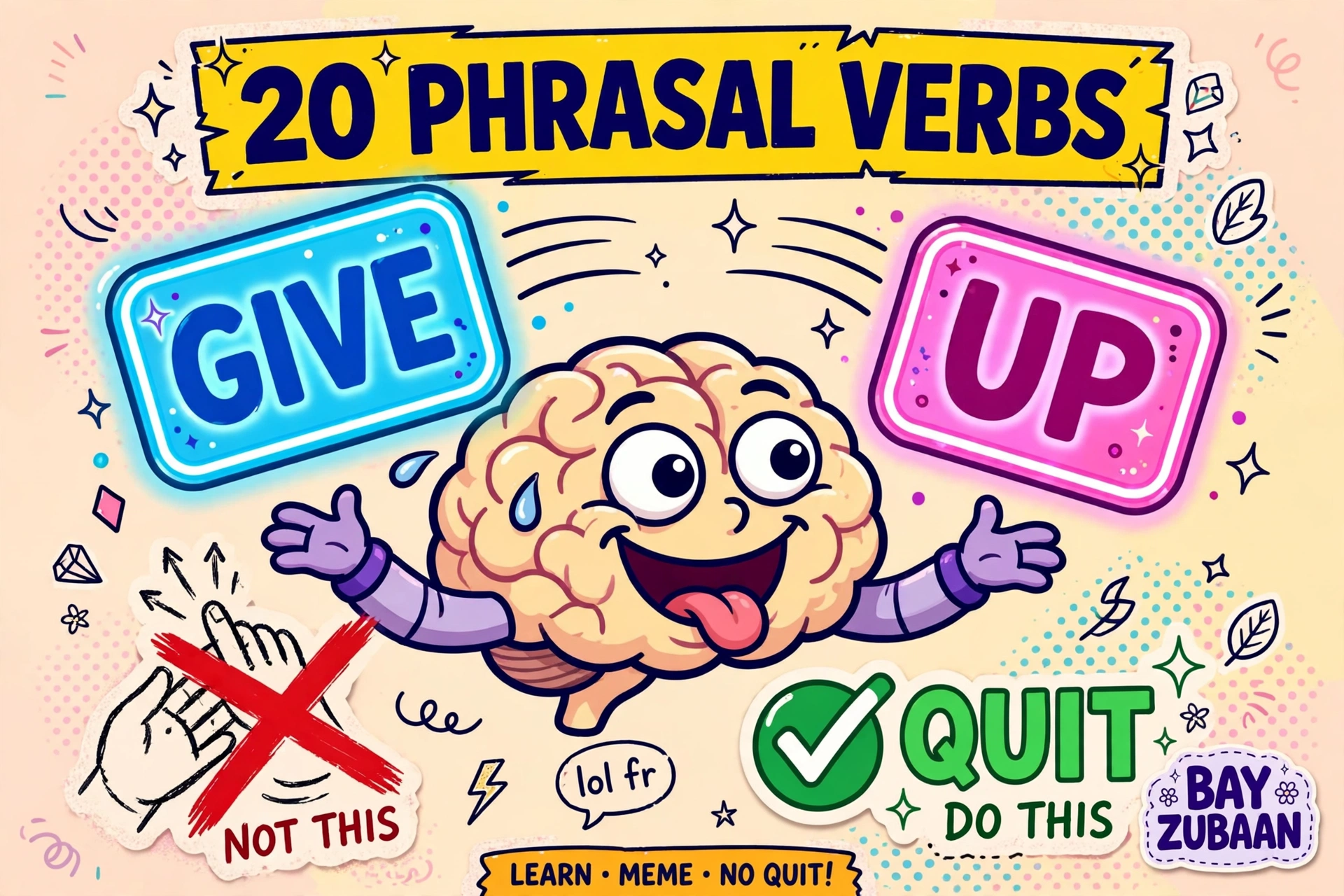
20 Phrasal Verbs Urdu and Hindi Speakers Translate Literally (and What to Say Instead)
If you grew up speaking Urdu or Hindi, phrasal verbs are the corner of English most likely to embarrass you in public. You know every single word in the sentence, and the sentence still means something else entirely. This guide to phrasal verbs for Urdu speakers collects the 20 worst offenders: everyday two-word verbs that learners translate piece by piece, get confidently wrong, and then keep using wrong for years. For each one you get the literal trap your brain falls into, the real meaning, a natural example sentence, and the simpler single word you can say instead while the phrasal verb settles into your memory. It is the same habit behind many common English mistakes Indian and Pakistani speakers make, and it is fixable in one sitting.
Why your brain translates word by word
Urdu and Hindi build sentences differently from English. Our languages put the verb at the end and use postpositions, small markers like ko, se, mein and par that sit after a noun and do the work of English prepositions. English phrasal verbs run on the opposite logic: a verb plus a small particle, and as the British Council’s grammar reference explains, the particle often changes the meaning of the verb completely. So when you meet “put up with”, your translating brain processes “put” plus “up” plus “with” and produces nonsense, because the three words together mean something that none of them means alone. It is the same first-language interference behind verbs that take no preposition in English, like saying “discuss about”. The fix is to stop reading the parts and start learning each phrasal verb as one sealed unit, exactly as you would memorise a single new word. Once you see the pattern, phrasal verbs for Urdu speakers become a vocabulary game instead of a guessing game.
1. Give up
The literal trap: “give” plus “up” sounds like handing something to someone taller.
The real meaning: to stop trying, or to surrender. If you give up smoking, you quit it. If an army gives up, it surrenders.
Example: “She gave up trying to fix the old scooter and bought a new one.”
Say instead: quit.
2. Put off
The literal trap: “put” plus “off” sounds like taking something off a table.
The real meaning: to postpone something to a later time. British Council teaching materials gloss it plainly as “postpone”.
Example: “We put off the meeting until Monday because the manager was travelling.”
Say instead: postpone.
3. Look after
The literal trap: “look” plus “after” sounds like staring at something behind you.
The real meaning: to take care of someone or something. This one never separates: you cannot “look someone after”.
Example: “My aunt looks after my grandmother during the day.”
Say instead: take care of.
4. Break down
The literal trap: “break” plus “down” sounds like smashing something into pieces on the floor.
The real meaning: if a machine breaks down, it stops working. If a person breaks down, they lose control of their emotions, usually in tears.
Example: “Our car broke down on the motorway, so we called for help.”
Say instead: stop working (machines), collapse in tears (people).
5. Run out of
The literal trap: “run” plus “out of” sounds like sprinting out of a room.
The real meaning: to use something up completely, so that none is left.
Example: “We ran out of milk, so I am going to the shop.”
Say instead: use up, or have none left.
6. Come across
The literal trap: “come” plus “across” sounds like walking to the other side of the road.
The real meaning: to find or meet something or someone by chance. The British Council’s grammar reference gives “come across” as “to find something by chance”.
Example: “I came across my old school diary while cleaning the cupboard.”
Say instead: find by chance, or encounter.
7. Get over
The literal trap: “get” plus “over” sounds like climbing over a wall.
The real meaning: to recover from an illness, a shock or a disappointment. The British Council gives “get over” as “recover from something”.
Example: “It took him two weeks to get over the flu.”
Say instead: recover from.
8. Take off
The literal trap: “take” plus “off” sounds like lifting something into the air.
The real meaning: when a plane takes off, it leaves the ground. When you take off a jacket, you remove it.
Example: “The flight to Lahore takes off at six in the morning.”
Say instead: depart (planes), remove (clothes).
9. Call off
The literal trap: “call” plus “off” sounds like shouting to someone far away, or ending a phone call.
The real meaning: to cancel something that was planned. The British Council gives “call off” as “to cancel”.
Example: “They called off the cricket match because of the rain.”
Say instead: cancel.
10. Bring up
The literal trap: “bring” plus “up” sounds like carrying something upstairs.
The real meaning: to start talking about a subject, or to raise a child. The British Council gives “bring up” as “start talking about a particular subject”.
Example: “She brought up the fee issue at the parent-teacher meeting.”
Say instead: mention, or raise.
11. Put up with
The literal trap: “put” plus “up” plus “with” sounds like placing something on a high shelf together with a friend. Complete nonsense, and that is exactly the point.
The real meaning: to tolerate something difficult or annoying. Both the British Council and Cambridge Dictionary define it as “tolerate”.
Example: “I cannot put up with this traffic noise any longer.”
Say instead: tolerate.
12. Look forward to
The literal trap: “look” plus “forward” sounds like staring into the distance. Learners also trip on the grammar, because the “to” here is a preposition, not part of an infinitive.
The real meaning: to feel happy and excited about something that is going to happen. The British Council gives “look forward to” as “be happy and excited about something that is going to happen”.
The grammar rule: Cambridge Dictionary’s grammar notes on look forward to state that the “to” is a preposition, so it must be followed by a noun or a verb in the -ing form. “I look forward to meeting you” is correct. “I look forward to meet you” is wrong, and it is one of the mistakes English teachers in Lahore, Delhi and Karachi correct most often.
Example: “We look forward to hearing from you soon.”
Say instead: anticipate (formal), or “can’t wait for” (informal).
13. Get on with
The literal trap: “get” plus “on” plus “with” sounds like climbing onto someone’s back.
The real meaning: to have a friendly relationship with someone, or to continue doing something. The British Council gives “get on with” as “like and be friendly towards someone”.
Example: “She gets on with her new colleagues really well.”
Say instead: be friendly with, or continue.
14. Turn down
The literal trap: “turn” plus “down” sounds like twisting a knob downward. Here the literal reading actually works in one case: “turn down the music” really does mean reduce the volume.
The real meaning: when the object is an offer, an invitation or a request, “turn down” means to refuse it. The British Council gives “turn down” as “to not accept an offer”.
Example: “He turned down the job offer because the salary was too low.”
Say instead: refuse, or reject.
15. Work out
The literal trap: “work” plus “out” sounds like doing your office job outdoors.
The real meaning: to exercise, or for a plan to develop successfully, as in “I hope it all works out”.
Example: “She works out at the gym three times a week.”
Say instead: exercise, or succeed.
16. Carry out
The literal trap: “carry” plus “out” sounds like carrying shopping bags out of a store.
The real meaning: to perform or complete something, like a task, a survey or an order. Formal, and very common in exams and office English.
Example: “The team carried out a survey of two hundred customers.”
Say instead: perform, or conduct.
17. Figure out
The literal trap: “figure” plus “out” sounds like solving a maths problem in the open air.
The real meaning: to understand something by thinking about it, or to find the answer to a problem.
Example: “I finally figured out why my phone battery drains so fast.”
Say instead: work out, or understand.
18. Check out
The literal trap: “check” plus “out” sounds like inspecting something outdoors.
The real meaning: to look at something in order to inspect it, or to leave a hotel and pay the bill.
Example: “Check out this website before you buy the course.”
Say instead: look at, or inspect.
19. Set up
The literal trap: “set” plus “up” sounds like placing something on a high shelf.
The real meaning: to start or establish something, like a business, a meeting or a system.
Example: “They set up a small online store during the lockdown.”
Say instead: establish, or start.
20. Hold on
The literal trap: “hold” plus “on” sounds like gripping something tightly with both hands.
The real meaning: in conversation it simply means “wait”. “Hold on a minute” is just a warmer way of saying “wait a minute”.
Example: “Hold on, I am coming with you.”
Say instead: wait.
How to stop translating word by word
Three habits fix this faster than memorising lists. First, learn each phrasal verb as one sealed chunk. Never write “give = dena, up = oopar” in your notebook. Write “give up = quit” as a single entry, and revise the chunk, never the parts. Second, when a new one appears in reading or conversation, check a learner’s dictionary instead of guessing from the parts. One quick lookup beats a month of confident misuse. Third, hear them in the wild: the shadowing technique trains your ear on how native speakers actually stress these chunks in fast speech, which is exactly when the literal translation habit does its worst damage. Give the list above one focused week, and phrasal verbs for Urdu speakers stop feeling like traps and start feeling like shortcuts.
The 20 at a glance
Twenty phrasal verbs for Urdu speakers in one revision table. Cover the right-hand column and test yourself before you peek.
| Phrasal verb | What it looks like | What it really means |
|---|---|---|
| give up | hand it upward | quit, stop trying |
| put off | take it off the table | postpone |
| look after | stare behind you | take care of |
| break down | smash into pieces | stop working, collapse in tears |
| run out of | sprint out of a room | use up completely |
| come across | walk to the other side | find or meet by chance |
| get over | climb over a wall | recover from |
| take off | lift into the air | depart, remove |
| call off | shout into the distance | cancel |
| bring up | carry upstairs | mention, raise |
| put up with | place it high with a friend | tolerate |
| look forward to | stare into the distance | anticipate with pleasure |
| get on with | climb onto someone | be friendly with, continue |
| turn down | twist a knob down | refuse an offer |
| work out | do office work outdoors | exercise, succeed |
| carry out | carry bags out of a shop | perform, conduct |
| figure out | solve sums in the open air | understand, find the answer |
| check out | inspect something outdoors | look at, inspect |
| set up | place it on a high shelf | establish, start |
| hold on | grip tightly | wait |
Frequently asked questions
Why are phrasal verbs so hard for Urdu speakers?
Because Urdu and Hindi have no equivalent structure. Our languages express the same ideas with single verbs plus postpositions, so the English habit of building new meanings by bolting a small particle onto a common verb feels unnatural at first. That is why phrasal verbs for Urdu speakers deserve their own study method: learn each one as a sealed chunk with an example sentence, instead of translating the parts.
Should I say “look forward to see” or “look forward to seeing”?
“Look forward to seeing.” The “to” in “look forward to” is a preposition, not part of an infinitive, so Cambridge Dictionary’s grammar guidance says it must be followed by a noun or a verb in the -ing form. “I look forward to meeting you” is correct; “I look forward to meet you” is one of the most corrected mistakes in South Asian classrooms.
Can I just avoid phrasal verbs and use single words?
You can survive without them, but you will sound like a textbook and you will miss half of what native speakers say. Phrasal verbs dominate everyday conversation, films and office small talk. The “say instead” word in each entry above is your safety net while you learn, not a permanent replacement.
How many phrasal verbs do I need for everyday English?
Fewer than you fear. A solid core of the most frequent ones handles most daily conversation, and frequency lists agree that a small set does most of the work. Master the 20 above first, since they appear constantly, then add new ones only as you meet them in real speech instead of memorising rare ones you will never use.
What is the fastest way to learn phrasal verbs for Urdu speakers?
Learn them inside sentences, never as isolated pairs. Take five from the list above each day, write one true sentence about your own life with each, and say the sentences aloud until the chunk feels like one word. Then shadow a native speaker using them, so your ear learns the stress pattern along with the meaning. That loop is the fastest way to make phrasal verbs for Urdu speakers stick for good.
Sources
- British Council LearnEnglish, “Phrasal verbs” grammar reference: the particle often changes the meaning of the verb; separable and inseparable types; call off = cancel; bring up = start talking about a subject; turn down = not accept an offer; come across = find by chance; get over = recover from something; get on with = like and be friendly towards someone; put up with = tolerate something difficult or annoying; look forward to = be happy and excited about something going to happen.
- Cambridge Dictionary, “Look forward to” (British Grammar): the “to” is a preposition, so it must be followed by a noun phrase or a verb in the -ing form.
- Cambridge Dictionary bilingual entries: “put up with” = to bear patiently, to tolerate.
Bookmark this guide to phrasal verbs for Urdu speakers and work through five entries a day. Read the trap, say the real meaning aloud, then use the “say instead” word in one sentence of your own. Within a week the chunks start feeling like single words, and that is when English stops surprising you.

Related Posts
When to Use Since vs For: The Present Perfect Rule Urdu and Hindi Speakers Get Wrong

Discuss About, Revert Back, Enter Into: 10 English Verbs That Need No Preposition