When to Use Since vs For: The Present Perfect Rule Urdu and Hindi Speakers Get Wrong
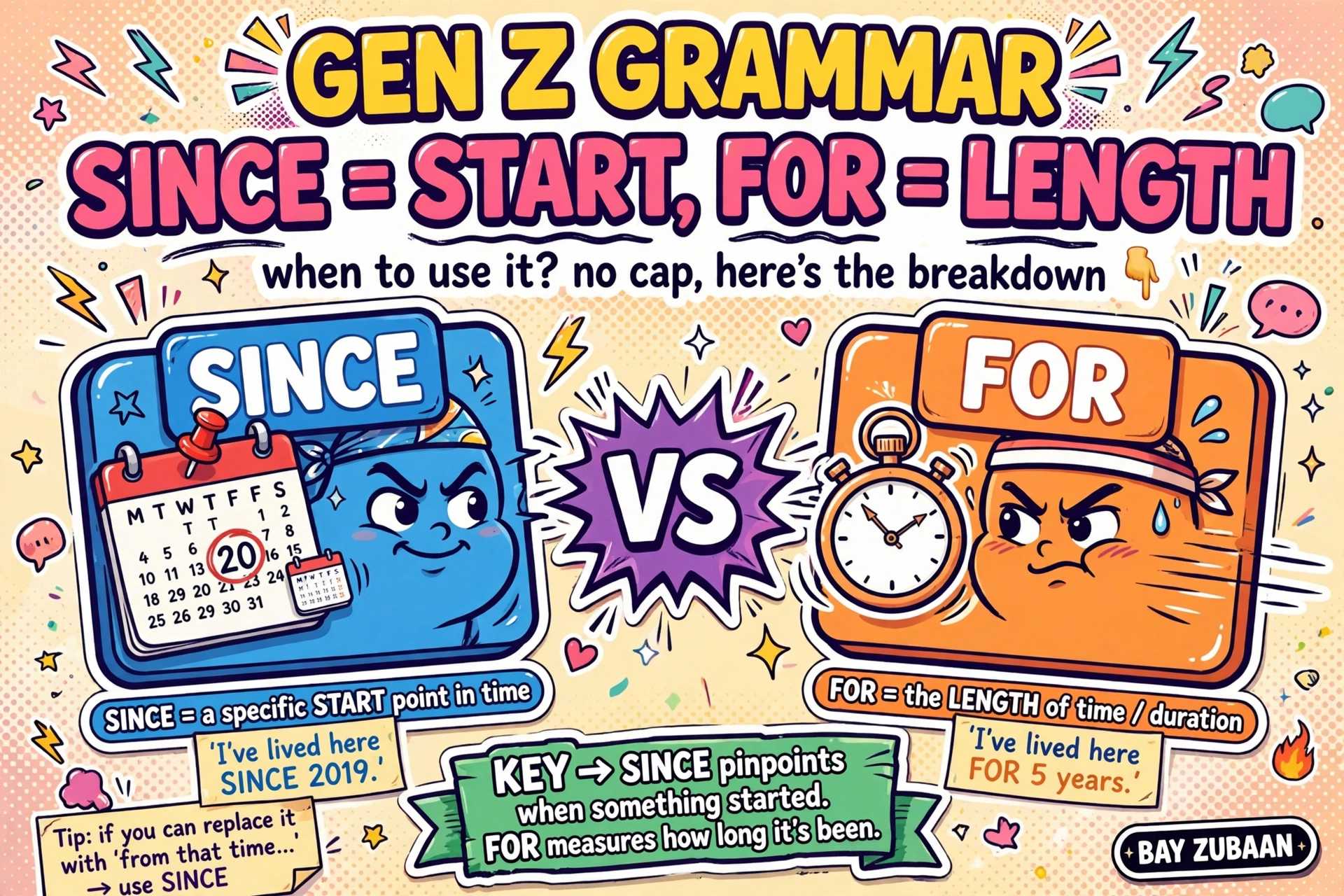
If you learned English in Lahore, Delhi, Karachi or Mumbai, there is one small grammar question that has followed you since your school days: do you say "since two years" or "for two years"? Most of us have said it wrong a hundred times, in exams, in job interviews and in WhatsApp messages to native speakers. The answer is short enough to learn in one sitting. Since marks the starting point. For marks the length of time. This guide explains when to use since and for in the present perfect, why Urdu and Hindi speakers mix them up, the ten mistakes our classrooms produce most, and a short practice set with answers so the rule sticks.
When to use since and for: the ten-second answer
Use since with the starting point: since Monday, since 2019, since morning, since I joined the company. Use for with the length of time: for three days, for two years, for ages, for a long time. Both pair with the present perfect when the situation started in the past and is still true now. "I have lived here since 2020" and "I have lived here for four years" say the same thing in two different ways. If you can answer the question "when did it start?", use since. If you can answer "how long?", use for. That one test resolves nearly every case, and it connects directly to the present perfect versus past simple difference you already know.
Why Urdu and Hindi speakers mix these two up
Urdu and Hindi never force you to make this choice, so your brain never learned it. Both languages use a single postposition, se (سے in Urdu, से in Hindi), where English splits the job three ways. "Peer se" can mean from Monday, since Monday, and in some contexts by Monday. When one word in your first language does the work of three words in English, you reach for whichever English word sounds closest, and that is how "since two years" is born. There is a second trap too. In Urdu and Hindi, a bare duration often needs no marker at all: "do saal" (two years) sits in the sentence by itself. So learners either drop the word entirely ("I have lived here two years") or pick the wrong one ("for Monday"). The fix is not memorising a longer list. It is learning the one question each word answers: since answers when it started, for answers how long it lasted. It is the same first-language interference behind the common preposition mistakes South Asian learners make, and it yields to the same treatment.
Since means the starting point
Since points at a moment on the calendar, or an event you could pin to one. Grammar references phrase it as a point in past time: a clock time, a day, a month, a year, or the moment something happened. Every item in the table below is a starting point, never a length.
| Starting point | Example sentence |
|---|---|
| since 9 o’clock | She has been in the meeting since 9 o’clock. |
| since Monday | He has been ill since Monday. |
| since morning | They have not eaten since morning. |
| since March | We have lived in this flat since March. |
| since 2019 | I have worked at the bank since 2019. |
| since Eid | She has been learning driving since Eid. |
| since the wedding | They have lived in Lahore since the wedding. |
| since I moved here | My Urdu has improved since I moved here. |
| since she was born | He has adored his daughter since she was born. |
| since we met | We have been friends since we met at university. |
Notice the last three rows. Since can introduce a whole clause, not just a single word: since I moved here, since she was born, since we met. The clause always names the moment things started, and the main verb stays in the present perfect because the situation continues now. A useful extra from the grammar books: since is normally used with perfect tenses only. You will not meet it with the simple present or simple future in standard English, which is one more reason it belongs with the present perfect in your mental filing cabinet.
For means the length of time
For measures the stretch, not the start. Every item below is a duration: a number plus a unit of time, or a set phrase that means a long stretch without naming a number.
| Length of time | Example sentence |
|---|---|
| for ten minutes | I have waited for ten minutes. |
| for an hour | We have been stuck in traffic for an hour. |
| for a week | She has been on leave for a week. |
| for two months | He has studied French for two months. |
| for six years | They have owned the shop for six years. |
| for a decade | The bridge has stood here for a decade. |
| for ages | I have not seen you for ages. |
| for a long time | We have known each other for a long time. |
| for a while | Stay for a while and have some chai. |
| for ever so long | It has taken for ever so long to get the visa. |
"For ages" deserves a special mention because learners distrust it. It is completely correct, informal British English for a very long time, and it follows the same rule: it names a stretch, so it takes for. If your phrase answers "how long" with a number and a unit, or with one of these set phrases for a stretch, for is always the word.
Why these two live with the present perfect
Since and for are not married to the present perfect by accident. The British Council’s LearnEnglish grammar reference explains that we use the present perfect, have or has plus the past participle, for past actions or states that are still connected to the present, and that we use it especially for unfinished states with for, since and how long. That is the whole logic of this article in one line. "I have lived here since 2020" means the living started in 2020 and continues now. The tense and the time word are doing the same job: connecting past to present.
This also explains the contrast your teachers kept drawing on the board. Compare "I worked in Dubai for two years" with "I have worked in Dubai for two years". The first uses the simple past because the job is finished; you left. The second uses the present perfect because you are still there. Same time word, for, but a different tense, because the situation’s connection to now has changed. That finished-versus-continuing distinction is the heart of the present perfect versus past simple lesson, and since and for are where it shows up most in daily speech. Whenever the starting point is in the past and the situation is still alive, reach for the present perfect plus since or for.
The since versus from trap
Here is where Urdu and Hindi speakers lose the most marks, because our se covers both words. In English, since and from are not interchangeable. Use since when the situation started in the past and is still continuing: "I have lived here since 2018." Use from when you name a range with an end, or a plan for the future: "I lived in Karachi from 2015 to 2019" (finished), "I will be on leave from Monday" (future plan). Three quick pairs make the split visible.
- "She has worked here since 2021" (she still works here) versus "She worked here from 2018 to 2021" (she left).
- "We have been friends since school" (still friends) versus "We were neighbours from 2010 to 2015" (we moved).
- "He has been on the team since January" (still on it) versus "The course runs from January to June" (a fixed schedule).
The pattern is mechanical. Since stands alone with an unfinished situation. From almost always brings a to with it, naming a finished or scheduled range. If your sentence could end with "and I still do", use since. If it ends with "and then it stopped", use from and to. This single distinction also cleans up the verb and preposition habits that examiners love to test, because it trains you to ask what the sentence means before choosing the small word.
Ten mistakes Urdu and Hindi speakers actually make
Every one of these comes from real classroom and office errors. Read the wrong version, feel why it sounds natural in Urdu or Hindi, then lock in the right one.
- 1. Wrong: "I have been waiting since two hours." Right: "I have been waiting for two hours." Two hours is a length, so it takes for.
- 2. Wrong: "She has lived here for 2019." Right: "She has lived here since 2019." A year is a starting point, so it takes since.
- 3. Wrong: "We have known each other from 2015." Right: "We have known each other since 2015." The friendship continues, so since, not from.
- 4. Wrong: "He has worked here since five years." Right: "He has worked here for five years." Five years is a duration.
- 5. Wrong: "They have been married for last June." Right: "They have been married since last June." Last June is a point on the calendar.
- 6. Wrong: "I have not seen him since a long time." Right: "I have not seen him for a long time." A long time is a stretch, not a start.
- 7. Wrong: "How long you are living here?" Right: "How long have you been living here?" How-long questions about an unfinished situation take the present perfect, and the answer uses for or since.
- 8. Wrong: "I am living here since 2020." Right: "I have lived here since 2020" (or "I have been living here since 2020"). Since pairs with perfect tenses, not the present continuous alone.
- 9. Wrong: "She has been ill from Monday." Right: "She has been ill since Monday." She is still ill, so the situation is unfinished.
- 10. Wrong: "We lived here since 2018." Right: "We have lived here since 2018." If you still live there, the simple past contradicts the since; use the present perfect. (If you moved away, say "We lived here from 2018 to 2022.")
Answering "how long" questions
Native speakers probe this rule with one question: "How long have you…?" Your answer must pick a side. "How long have you studied English?" Answer with a length: "For five years." Answer with a start: "Since 2021." Both are correct, and swapping between them is excellent practice. Try it on your own life right now: how long have you lived in your city, worked at your job, owned your phone? Give each answer twice, once with for and once with since. If you can do that smoothly, the rule has moved from your notebook into your mouth, which is the only place that matters.
Quick practice: ten sentences
Fill each gap with since or for, then check the answers below. No peeking.
- I have lived in Karachi ___ 2018.
- She has been ill ___ three days.
- We have been friends ___ we were children.
- He has worked at the bank ___ a decade.
- They have not eaten ___ morning.
- I have known her ___ ages.
- The shop has been closed ___ Monday.
- We have waited ___ over an hour.
- She has wanted to be a doctor ___ she was ten.
- It has rained ___ last night.
Answers: 1. since (2018 is a starting point) 2. for (three days is a length) 3. since (a clause naming when it started) 4. for (a decade is a length) 5. since (morning is a point in the day) 6. for (ages is a set phrase for a stretch) 7. since (Monday is a day) 8. for (over an hour is a length) 9. since (a clause naming the start) 10. since (last night is a point in time). Ten out of ten means the habit is installed. Anything less means one more read of the two tables above.
Three memory hooks that survive exams
- Since starts with S, and so does Starting point. See a date, a day, a year or an event, and the S-word is waiting.
- For answers "how long", which asks for a length. Number plus time unit, or a stretch phrase like ages or a long time, always takes for.
- The calendar test. Can you point at it on a calendar? Since. Can you only measure it like a piece of rope? For.
Recap: when to use since and for
| Use since when you name… | Use for when you name… |
|---|---|
| a clock time: since 9 o’clock | minutes or hours: for ten minutes |
| a day: since Monday | days or weeks: for a week |
| a month or year: since 2019 | months or years: for six years |
| an event: since Eid, since the wedding | a stretch phrase: for ages, for a long time |
| a clause: since I moved here | anything answering "how long?" |
| anything answering "when did it start?" |
Frequently asked questions
When to use since vs for in the present perfect?
When to use since and for comes down to one question. Use since when you name the starting point: since Monday, since 2019, since I joined. Use for when you name the length of time: for three days, for two years, for ages. Both pair with the present perfect when the situation began in the past and continues now.
Why is "since two years" wrong?
Because "two years" is a length of time, not a starting point. Since needs a point you could circle on a calendar, like 2022 or last Monday. For lengths like two years, three days or ages, the correct word is for: "I have lived here for two years."
Can I use since with the simple past?
Not in standard English. Since normally pairs with perfect tenses only, so "I lived here since 2018" is wrong two ways: the tense and the pairing. Say "I have lived here since 2018" if you still live there, or "I lived here from 2018 to 2022" if you moved away.
What is the difference between since and from?
Since marks a start that continues to now: "I have worked here since 2021." From marks a range with an end, or a future plan: "I worked here from 2018 to 2021", "I will be on leave from Monday." Urdu and Hindi use se for both, which is exactly why this pair needs deliberate practice.
Is "for ages" correct English?
Yes. "For ages" is standard informal British English meaning for a very long time, as in "I have not seen you for ages." It follows the rule perfectly: it names a stretch of time, so it takes for, never since.
Sources
- British Council LearnEnglish, "Present perfect" grammar reference: the present perfect (have or has plus past participle) describes past actions or states still connected to the present, and is used for unfinished states especially with for, since and how long.
- EC English Learn English, "Present Perfect with For and Since": for is used to talk about a period of time; since is used to talk about a specific point in time, or the time when the action started.
Bookmark this guide to when to use since and for, then use it the loud way: answer "how long have you" questions about your own life twice, once with for and once with since, until both versions feel automatic. The rule is small, the payoff is permanent, and your examiners will notice the difference.

Related Posts

20 Phrasal Verbs Urdu and Hindi Speakers Translate Literally (and What to Say Instead)

Discuss About, Revert Back, Enter Into: 10 English Verbs That Need No Preposition