Is OET Accepted in the USA? What Doctors Need to Know for 2026
Is OET Accepted in the USA? What Doctors Need to Know for 2026
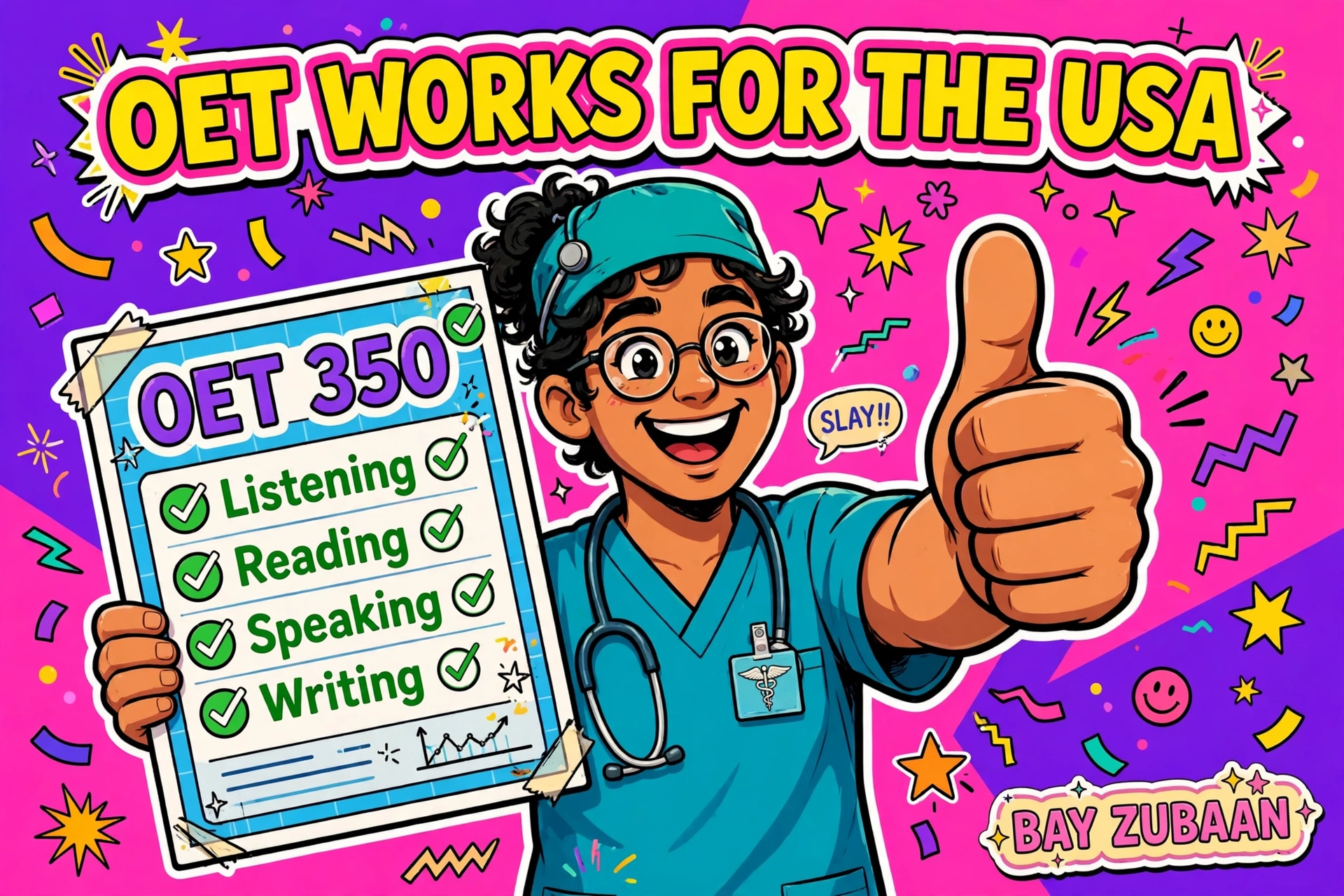
Short answer: Is OET accepted in the USA? Yes. For doctors, the Educational Commission for Foreign Medical Graduates (ECFMG) accepts the Occupational English Test (OET) Medicine as the English and communication-skills requirement for certification, and it has done so since the Pathways for ECFMG Certification replaced USMLE Step 2 Clinical Skills. You must score at least 350 in Listening, Reading and Speaking, and at least 300 in Writing, all in a single test sitting, with no exemptions for native speakers. For nurses, the picture is separate: CGFNS International accepts OET for its VisaScreen immigration screening, and dozens of state nursing boards accept it for licensure.
If you are a doctor outside the United States planning your route to residency, that short answer hides several important details: which version of the test counts, what score thresholds actually apply, how long your score stays valid, and the myths that cost candidates time and money. This guide works through each one, with every claim tied to a real source.
How OET ended up in the American system
Until 2020, international medical graduates proved their clinical and communication skills through USMLE Step 2 Clinical Skills (Step 2 CS), an in-person practical exam. When Step 2 CS was suspended during the COVID-19 pandemic and then permanently discontinued, ECFMG had to replace it. The replacement was the Pathways for ECFMG Certification, a set of routes that assess clinical and communication skills through other means.
English assessment became one leg of every Pathway, and in late 2020 ECFMG named the test it would accept: OET Medicine. The choice was not random. OET is a healthcare-specific English test, built around clinical consultations, referral letters and patient handovers rather than essays about architecture or agriculture. That is why ECFMG accepts it as evidence of the communication skills Step 2 CS used to assess. The Foundation for Advancement of International Medical Education and Research (FAIMER) also recognised the test at the same time, according to E2Language’s coverage of the announcement.
This is the key fact for doctors: OET is not merely “accepted” in the USA in some vague sense. It is the required communication-skills evidence for ECFMG certification, and ECFMG certification is what lets an international medical graduate enter an accredited US residency programme and sit Step 3.
What “accepted” means for doctors: ECFMG certification
Be precise here, because the acceptance is narrower than the headline suggests. OET is accepted by ECFMG as part of the Pathways for ECFMG Certification. That is the certification international medical graduates need for residency and licensure, and it is the only part of the American doctor route where an English test appears at all.
Two things follow from that.
First, you do not need OET (or any English test) to register for USMLE Step 1 or Step 2 Clinical Knowledge. The English requirement comes from ECFMG certification, not from the USMLE itself. This matters for planning your timeline: many candidates take the Steps first and sit OET later.
Second, OET does not replace anything else. You still need to pass Step 1 and Step 2 CK, have your medical diploma verified, and complete one of the Pathways. OET is one requirement among several, not a shortcut around the others.
The exact ECFMG score requirements
ECFMG states its passing requirement on its official OET page, and it is stricter than most candidates expect. To meet the requirement you must attain:
- Listening: minimum 350 (Grade B)
- Reading: minimum 350 (Grade B)
- Speaking: minimum 350 (Grade B)
- Writing: minimum 300 (Grade C+)
All four scores must come from one test administration. This is the detail that surprises people most. ECFMG does not accept “clubbing”, the practice of combining scores from two different sittings. If one sub-test falls below its threshold, you retake all four, not just the failed one. There is no limit on how many times you can retake, subject to scheduling availability.
Notice that Writing has a lower bar than the other three: 300 rather than 350. Do not read that as permission to relax. Preparation sites consistently describe Writing as the sub-test that candidates underestimate and fail most often, because it demands a disciplined referral or discharge letter written from messy case notes under time pressure, not just correct grammar.
Score shelf life matters too. For the 2027 Pathways, ECFMG requires the qualifying score to have been attained on or after January 1, 2025. Older scores, even ones that previously met the bar, do not count for the new cycle. If you passed OET Medicine in 2024, check which Pathway year you are applying under before assuming your result carries over.
One practical step is easy to forget: ECFMG must receive your scores directly from OET. Give your ECFMG/USMLE ID when you book the test so your passing result transfers electronically within three business days of release, or use the “Manage Verifier Access” feature in your OET account afterwards to release them. Make sure your name and date of birth match across both systems, or the transfer can stall.
The four sub-tests, doctor version
Doctors must take OET Medicine specifically. Other OET professions (Nursing, Dentistry, Pharmacy and the rest) do not count for ECFMG certification. The four sub-tests use real clinical material:
Listening has you follow patient consultations and healthcare presentations, answering questions as you listen. Reading works through healthcare texts under genuine time pressure, the way you would scan a guideline or a discharge summary. Writing gives you a set of patient case notes and asks you to select what is relevant and produce a professional letter, usually a referral or discharge letter. Speaking is two role-played patient consultations with a trained interlocutor, where you are assessed on patient-centred communication: clarity, tone and accuracy, not just vocabulary.
Because the vocabulary is familiar, many doctors find OET more natural than a general English test. That comfort is the trap: the scoring rewards structure, relevance and clinical judgement, so prepare for each sub-test as a separate skill. A low-tech way to build the speaking side on your own is our shadowing technique guide, which pairs well with OET speaking preparation.
The no-exemptions rule
Here is the rule that provokes the most disbelief, and it is stated plainly in ECFMG guidance and repeated by every serious preparation source: there are no exemptions. Every Pathways applicant must pass OET Medicine, regardless of native language, regardless of whether your medical school taught in English, and regardless of your citizenship. A US citizen who trained in English and passed both USMLE Steps in English still needs OET for certification. IELTS and TOEFL do not substitute.
This strictness is also why coaching blogs describe the rule as controversial. But from ECFMG’s perspective it is deliberate: the test is treated as evidence of communication skills, the very thing Step 2 CS measured, not as a verdict on whether you speak English at all.
Nurses have a separate acceptance route
So far this guide is about doctors. For nurses, OET’s acceptance in the USA runs through different bodies. CGFNS International, which handles VisaScreen immigration screening for foreign-educated nurses, has accepted the OET Test since 1 August 2022. Dozens of state nursing boards also accept OET for licensure; coverage summaries put the number above forty. The thresholds differ by route, so nurses should check the requirements of the specific state board or the VisaScreen application they are filing. The E2Language announcement from late 2020 noted that Florida and Oregon were among the first state nursing boards to recognise the test.
One caution for everyone: OET is not a general US immigration English test. Its acceptance in America is professional and specific: ECFMG for doctors’ certification, CGFNS and state boards for nurses. It does not appear in the routes that universities or general visa categories use, where IELTS and TOEFL still rule.
Practicalities: cost, dates and booking
The full four-sub-test OET on Computer currently lists at US$455 for test venues in the United States; the general list price is AU$587. A point worth knowing before you budget: OET does not sell individual sub-tests in the USA, so plan for the full four-sub-test price each time you sit. Test dates run frequently throughout the year, with many computer-based dates each month, but booking closes seven days before the test, so candidates aiming for the Match should work backwards from their ECFMG deadlines. For the 2027 Pathways, ECFMG requires timely applications by January 31, 2027 and must receive your OET results by that date, so testing in the autumn leaves a retake buffer; testing in January does not.
Common questions
Is OET easier than IELTS for doctors?
For most doctors, yes in practice, because the tasks are clinical rather than academic. Comparing the two tests directly for doctors is worth doing before you choose a preparation route, and our OET vs IELTS for doctors comparison walks through the differences section by section.
Do I need OET for USMLE Step 1 or Step 2 CK?
No. The USMLE Steps have no English-test requirement. OET enters the picture through ECFMG certification, which international graduates need for residency and for Step 3.
Can I take OET at home for ECFMG?
OET offers Paper, Computer at a venue, and Test@Home for select candidates. Confirm with ECFMG and OET that your chosen format and venue are accepted for your Pathway before booking.
What happens if I miss the score on one sub-test?
You retake all four sub-tests in a single sitting. There is no way to carry a passing score forward or to retake one section alone.
I trained in English. Do I really have to take it?
Yes. ECFMG applies the requirement to all Pathways applicants with no exemptions for native speakers, English-medium training or citizenship.
Does my OET score expire?
OET results are generally treated as valid for two years, but what matters is ECFMG’s rule: for the 2027 Pathways your qualifying score must be from on or after January 1, 2025. Always check the current Pathway year before relying on an older result.
The bottom line
Is OET accepted in the USA? For doctors, the answer is a firm yes with a precise shape: OET Medicine is the accepted, and in fact required, English and communication-skills evidence for ECFMG certification, with set score thresholds in a single sitting and no exemptions. It does not replace the USMLE Steps, it is not needed to sit them, and IELTS and TOEFL are not accepted for this purpose. For nurses, acceptance runs through CGFNS VisaScreen and state nursing boards. The American system accepted OET in late 2020 and the requirement has only become more embedded since. Book it with the same seriousness you give the Steps, prepare for Writing as its own discipline, and make sure your score reaches ECFMG in time.
- ECFMG, “Assessment of Communication Skills, Including English Language Proficiency” (OET score requirements: 350 Listening/Reading/Speaking, 300 Writing, single administration, no limit on retakes, 2027 Pathways scores on or after January 1, 2025): http://www.ecfmg.org/certification-pathways/oet.html
- IMGPrep, “OET for IMG Residency Match” (OET Medicine four sub-tests; 350/350/350/300 in a single administration; 2026 Pathways scores on or after January 1, 2024): https://www.imgprep.com/oet-for-img-residency-match
- E2Language, “OET Now Accepted in US” (OET accepted in the United States for medical professionals; ECFMG and FAIMER recognising the test; Florida and Oregon nursing boards from late 2020): https://www.e2language.com/blogs/oet/oet-in-the-united-states-a-new-approach-to-speaking-and-writing
- SpainExchange FAQ, “Do the USA accept OET?” (OET accepted for VisaScreen applications with CGFNS International from 1 August 2022; more than 40 state nursing boards accept OET): https://www.spainexchange.com/faq/do-the-usa-accept-oet
- SpeakShark, “OET Medicine Test Dates in the USA: September 2026” (US$455 for the full OET on Computer in the USA; individual sub-tests not sold in the USA; 350/350/350/300 in one administration; 2027 Pathways test on or after January 1, 2025; applications and score receipt due January 31, 2027): https://speakshark.com/blog/oet-medicine-test-dates-september-2026-usa
- NextStepsUSMLE, “OET Exam Fees 2026” (no exemptions regardless of native language, language of instruction or citizenship; IELTS and TOEFL do not substitute; Writing the most underestimated sub-test; 2027 Pathways scores on or after January 1, 2025): https://nextstepsusmle.com/blog/what-is-oet-exam-how-much-does-it-costs
- Interface.edu.pk, “TOEFL/OET for USMLE?” (updated October 2026: Step 2 CS discontinued January 2021, Pathways introduced; OET Medicine part of every Pathway; no exceptions for native speakers; TOEFL and IELTS not accepted for ECFMG Certification): https://www.interface.edu.pk/tests/usmle/USMLE-Toefl
- Blueprint Prep, “What You Really Need to Know About Being an International Medical Graduate” (ECFMG certification requires English proficiency evidence; OET required even for US citizens trained in English): https://blog.blueprintprep.com/medical/what-you-really-need-to-know-about-being-an-international-medical-graduate/