What Happens in the OET Speaking Role-Play?
What Happens in the OET Speaking Role-Play?
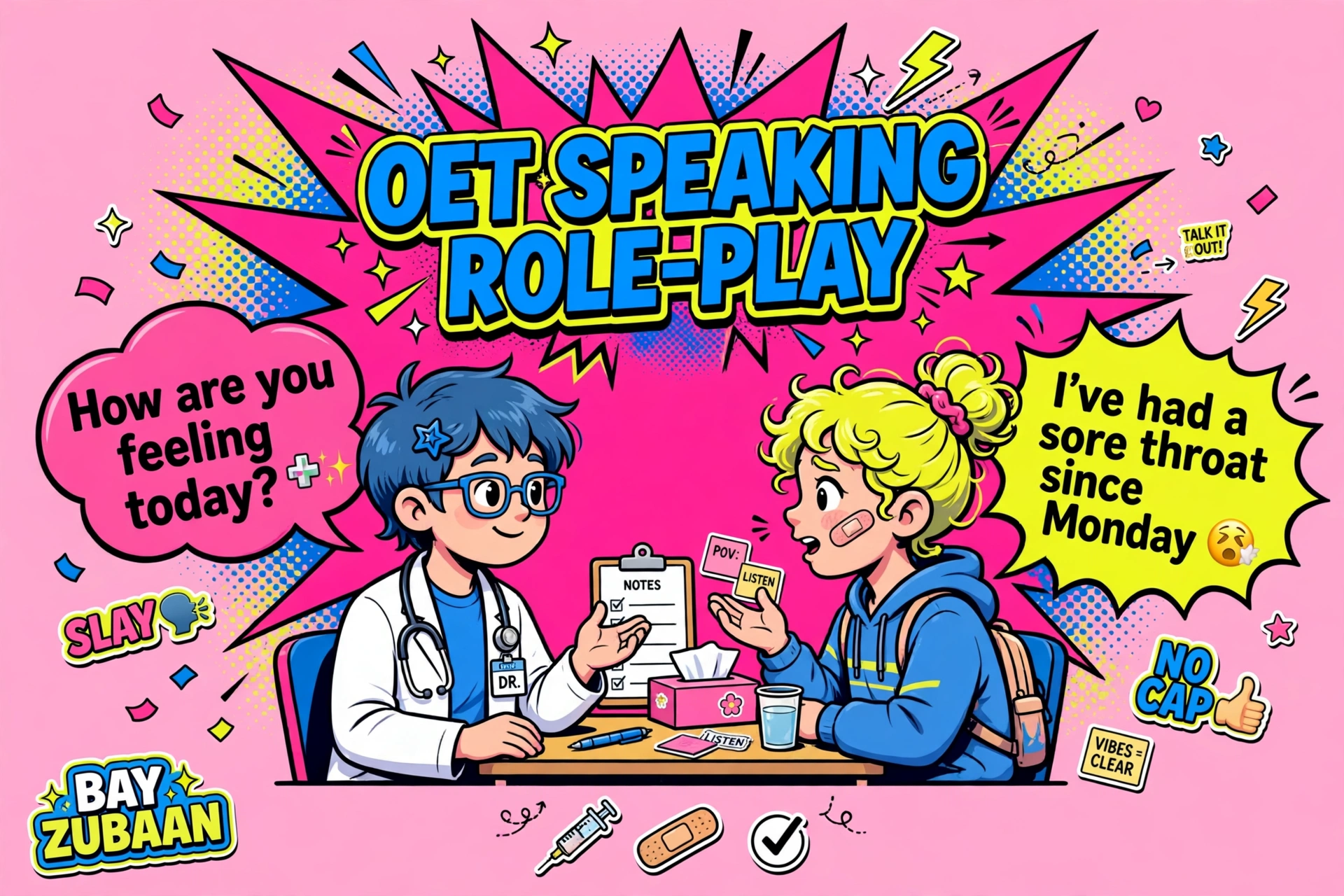
What happens in OET speaking test? In the OET speaking test, you complete two profession-specific role-plays with a trained interlocutor who plays a patient, a relative or a carer, with about five minutes of conversation and three minutes of preparation for each. The whole exchange is recorded and marked later by at least two trained OET assessors, not the person sitting across from you, against nine criteria that split into linguistic skills and clinical communication. Knowing this format in advance removes most of the mystery, and the mystery is usually what makes candidates nervous.
This is the third article in our OET series on Bayzubaan. Earlier this week we asked is OET accepted in the USA and explained how you pass the OET writing sub-test. Now we turn to the sub-test that makes most candidates sweat: the speaking role-play, the part where you actually have to talk to a human being.
What happens in OET speaking test: the format, step by step
The OET speaking sub-test takes around 20 minutes in total and follows the same structure across all of OET’s professions, from nursing and medicine to veterinary science. Everything below comes from OET’s own published description of the sub-test, so treat it as the ground truth rather than rumour.
1. Identity check and warm-up (a few minutes, not assessed). The interlocutor checks your identity and profession, then opens a short warm-up conversation about your professional background. OET is explicit that this part is not assessed. It exists so you can settle in, get used to the interlocutor’s voice and shake off the nerves before the real work starts.
2. Role-play one. The interlocutor hands you a role-play card. The card explains the situation and what you are required to do, and you keep it with you while you perform the role-play. You get about three minutes to read the card and plan, and you may write notes on it if you like. You can also ask the interlocutor questions about the card during this preparation time. Then the role-play runs for about five minutes: you play your own professional role while the interlocutor plays a patient, a relative or a carer (for veterinary science, the owner or carer of the animal).
3. Role-play two. A fresh card, a fresh scenario, and the same routine: three minutes of preparation, about five minutes of conversation.
Two details matter here. First, the role-plays are based on typical workplace situations and reflect the demands made on a health professional in those situations, from gathering information and explaining procedures to reassuring anxious patients. Second, different role-plays are used for different candidates at the same test administration, so memorising someone else’s scenario from a forum will not help you. The interlocutor follows a script so that the test structure is similar for every candidate, and they hold detailed background information to use during each role-play.
It is also worth understanding how different this is from a general English interview, which we explored in our comparison of OET vs IELTS for doctors. Nobody asks for your opinion on healthcare policy. You simply have to behave like a competent, kind clinician in English.
What the interlocutor actually does (and does not do)
Here is the fact that surprises most candidates: your test-day interlocutor plays no role in the assessment of your performance. The whole speaking test is recorded, and it is the audio recording that is assessed, marked independently by a minimum of two trained OET assessors. Neither assessor knows what scores the other has given you, or what scores you achieved on the other sub-tests.
So what does the interlocutor actually do? They play their part: the patient with the worry, the relative with the difficult question, the carer who needs reassurance. They follow a script, they hand you the card, they answer clarification questions during preparation time, and they bring the role-play to a close when the five minutes are up. They are your scene partner, not your judge.
This changes how you should behave in the room. Trying to impress the interlocutor with complex sentences is wasted effort, because the assessors listening to the recording later care about something else entirely: whether a real patient would understand you, trust you and feel heard.
What the assessors really mark: the 9 criteria explained
Your performance on each of the two role-plays is scored against nine criteria. OET groups them into two sets, and this split is the key to the whole sub-test. As OET puts it, the test assesses the language of care: how something is said matters as much as what is said (OET on real-world communication).
The four linguistic criteria (each scored 0 to 6)
- Intelligibility: pronunciation, intonation, stress, rhythm and accent. Can the listener understand you without straining? Your accent is fine as long as it does not block understanding.
- Fluency: the rate and flow of your speech. Smooth, natural pacing beats racing to cover everything or stalling in long silences.
- Appropriateness of Language: language, register and tone that suit the situation and the patient. This is where medical jargon costs you. “Myocardial infarction” said to a frightened patient should become “a problem with the blood supply to your heart”.
- Resources of Grammar and Expression: the range and accuracy of your language, including your ability to paraphrase when a word escapes you and to hold longer explanations together.
The five clinical communication criteria (each scored 0 to 3)
- Relationship Building: how you open the interaction, whether you show an attentive and respectful attitude, a non-judgmental approach and genuine empathy for the patient’s predicament.
- Understanding and Incorporating the Patient’s Perspective: do you listen to what the patient actually cares about and weave it into your responses, instead of bulldozing through your own agenda?
- Providing Structure: do you organise the conversation so the patient can follow it, with clear transitions and signposts between topics?
- Information Gathering: the type of questions you ask, how you mix open and closed questions, and how carefully you listen to the answers.
- Information Giving: how clearly you explain, whether you check the patient understood, and whether you summarise the plan at the end.
Each sub-test is reported on a scale of 0 to 500, mapped to letter grades from A (highest) to E (lowest). Most registering bodies ask for grade B, which is a score of 350, in each sub-test. OET’s own guidance for reaching grade B is a high level of performance across all nine criteria, which typically means mostly 5 out of 6 on the linguistic criteria and mostly 2 out of 3 on the clinical communication criteria.
Phrases that buy you time in the role-play
Five minutes is short, but blanking out mid-sentence feels like an eternity. The trick is not memorised speeches. OET warns that candidates who rely on memorised material tend not to perform to their full potential, because assessors score how you respond to the task on the day. The trick is flexible frames you can reach for while your brain catches up:
- To open warmly: “Good morning, Mr Ahmed. My name is Sara and I am the nurse looking after you today. Thank you for coming in. How are you feeling at the moment?”
- To buy thinking time: “That is a really good question. Let me think about the best way to explain this.” Or: “Before I answer, could you tell me a little more about how that feels?”
- To acknowledge emotion: “I can see this is worrying you, and that is completely understandable.” Or: “Many people feel nervous about this, so you are not alone.”
- To signpost structure: “There are three things I would like to cover. First… Second… And finally…” Or: “Let me summarise what we have agreed so far.”
- To check understanding: “Could you tell me in your own words what you will do when you get home?” Or: “Does that make sense so far, or would you like me to go over anything again?”
- To close: “To sum up, we have agreed that you will… Do you have any other questions for me today?”
Notice that every one of these doubles as evidence for the clinical communication criteria: empathy, structure, checking understanding. That is not a coincidence. The phrases are doing the marking work for you. For fluency practice between mock tests, our shadowing technique guide is a strong fit, because it trains the smooth delivery that the fluency criterion rewards.
Common mistakes that cost marks
- Performing for the interlocutor. They do not mark you. Perform for the recording: speak clearly and keep the patient at the centre of everything you say.
- Rushing to tick off every card bullet. Task completion is not one of the nine criteria. Covering the card matters only because it gives assessors more evidence of your communication. A calm, structured half of the card beats a frantic scramble through all of it.
- Reciting memorised answers. OET’s assessor guidance says candidates who use memorised material or rely on techniques that worked in other circumstances tend not to perform to their full potential. Assessors are trained to score how you respond to the particular task on the day.
- Using clinical jargon with the patient. The appropriateness criterion rewards language the patient can understand. Translate your knowledge into plain words.
- Never checking understanding. Information giving without “does that make sense?” or a summary leaves easy marks on the table.
- Skipping the opening. Relationship building starts in the first thirty seconds. A warm greeting and a clear introduction cost nothing and set the tone for every criterion that follows.
Frequently asked questions
What happens in the OET speaking test?
What happens in OET speaking test? You complete two profession-specific role-plays with a trained interlocutor who plays a patient, relative or carer. You get about three minutes to prepare for each role-play from a card, then about five minutes of conversation. The exchange is recorded and marked later by at least two trained OET assessors against nine criteria.
Does the OET interlocutor mark your speaking test?
No. Your test-day interlocutor plays no role in the assessment of your performance. The whole speaking test is recorded, and the audio recording is marked independently by a minimum of two trained OET assessors, neither of whom knows the other’s scores.
How many role-plays are in the OET speaking test?
There are two role-plays in the OET speaking test. Each lasts about five minutes, with about three minutes of preparation time before each one, and the whole speaking sub-test takes around 20 minutes including the unassessed warm-up conversation.
What are the 9 assessment criteria for OET speaking?
The nine criteria are four linguistic criteria (Intelligibility, Fluency, Appropriateness of Language, Resources of Grammar and Expression), each scored 0 to 6, and five clinical communication criteria (Relationship Building, Understanding and Incorporating the Patient’s Perspective, Providing Structure, Information Gathering, Information Giving), each scored 0 to 3.
How long do you get to prepare for each OET role-play?
You get about three minutes to prepare for each OET role-play. You receive a card explaining the situation and what you are required to do, you may write notes on it, and you can ask the interlocutor questions about the card during this time.
What score do you need to pass OET speaking?
OET does not set a single pass mark; the requirement depends on your registering body. Most healthcare boards require grade B, which is a score of 350 on the 0 to 500 scale, in each sub-test. OET’s guidance for grade B is mostly 5 out of 6 on the linguistic criteria and mostly 2 out of 3 on the clinical communication criteria.
Sources
- OET support: How will I sit the Speaking sub-test? (two role plays, role-play card, profession-specific delivery)
- OET: Building real-world and workforce-ready communication (linguistic and clinical communication skills, the language of care)
- OET’s official “How is speaking assessed in OET?” wording, including the nine criterion names and definitions and the two-assessor marking process, as published in OET’s test information materials (exact wording cross-checked against OET-aligned sources quoting the official text verbatim).
Related reading