The 20 Preposition Mistakes Urdu Speakers Make Most (“Discuss About”, “Married With”, “Reply Back”)
What are the most common preposition mistakes in English for Urdu speakers? The short answer: the same twenty errors show up again and again, and nearly all of them come from one root cause. Urdu does not have prepositions at all. It has postpositions, little markers like se, ko, mein and par that sit after the noun instead of before it. Research on Pakistani learners found that the single biggest reason for preposition errors is the literal translation of these Urdu case markers and postpositions into English prepositions, a process linguists call interlingual correlation (Khurshid and Hassan, Kashmir Journal of Language Research).
That means these common preposition mistakes in English are not random. They are predictable, which makes them fixable. This guide walks through all twenty, with the wrong version, the right version, and the Urdu logic that causes each one, so the correction sticks.
Why does Urdu cause so many preposition mistakes in English?
English prepositions come before the noun: in the room, to Ali, about the plan. Urdu postpositions come after it: kamre mein (room in), Ali se (Ali with/from), mez par (table on). One Urdu postposition often does the work of several English prepositions. The Urdu marker se, for example, can mean with, from, by or since depending on context, and learners who map se to one English word carry that one word into every sentence.
A second cause is verbatim translation of whole phrases. Learners think the Urdu sentence first, then swap words one by one, which breaks English collocation rules. The Kashmir Journal of Language Research study of Pakistani grade thirteen students identified this as “transfer”: translating L1 sequences verbatim in violation of L2 grammar rules. A related analysis of Urdu case clitics as postpositions (Global Social Sciences Review, 2024) confirms the structural mismatch: Urdu accusative and dative markers like ko do not line up neatly with English to, which is exactly why phrases like “married with” feel right to an Urdu speaker and wrong to an English one.
Now, the twenty mistakes, in three groups.
Group 1: Verbs that need no preposition at all
English has a set of transitive verbs that take a direct object with nothing in between. Urdu and Hindi speakers often insert a preposition by translating from Urdu, where a postposition naturally sits there.
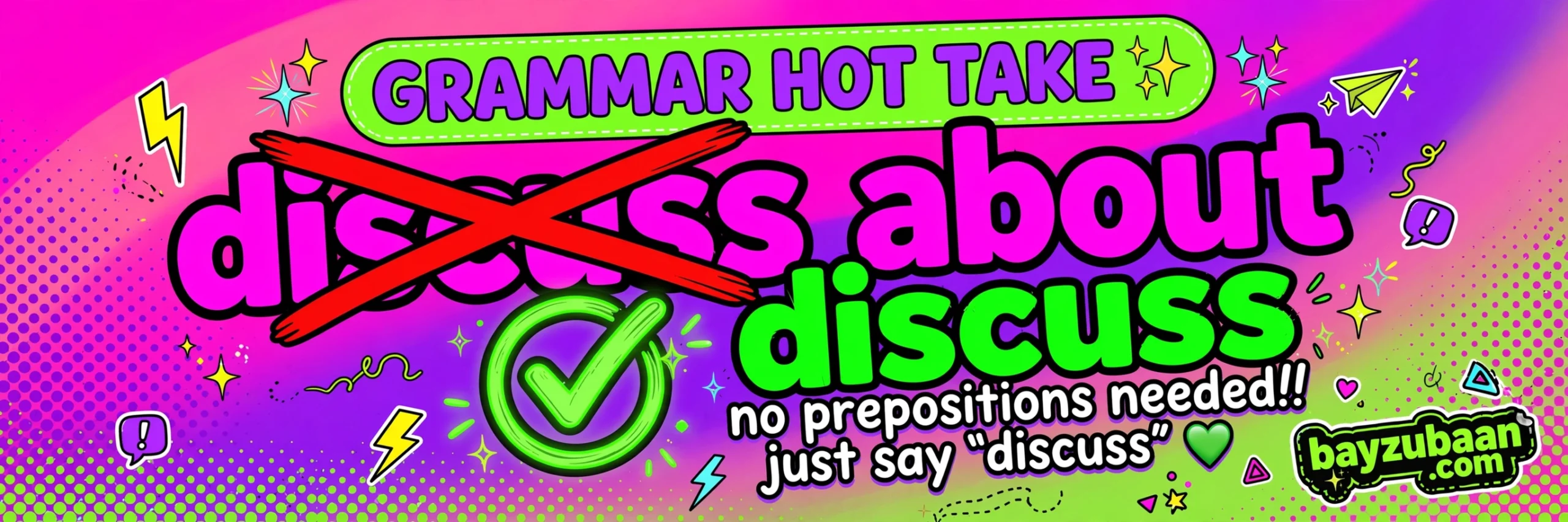
1. “Discuss about” should be “discuss”
Wrong: We discussed about the exam results.
Right: We discussed the exam results.
The verb discuss already means “talk about”, so adding about doubles the meaning. Cambridge Dictionary’s British Grammar guide lists discuss explicitly among the words we do not use with about, and its dictionary entries warn “to discuss (not discuss about) a problem”. The Urdu logic: ke baare mein baat karna (to talk about), so speakers keep the about when they switch to discuss.
2. “Reach at” should be “reach”
Wrong: We reached at the station on time.
Right: We reached the station on time.
Reach is complete on its own: it takes a direct object, never at or to. The Urdu logic: station par pahunchna, where par (on/at) sits after the noun, so the speaker reaches for an English preposition to stand in for it.
3. “Enter into” and “enter in” should be “enter”
Wrong: He entered into the room quietly. / She entered in the hall.
Right: He entered the room quietly. / She entered the hall.
Enter already means “go into”, so into repeats the idea. The only exception is formal or figurative use such as “enter into an agreement”, which is a fixed phrase. The Urdu logic: kamre mein daakhil hona, where mein (in) demands a stand-in, and learners pick into or in.
4. “Comprise of” should be “comprise”
Wrong: The team comprises of ten members.
Right: The team comprises ten members. (Or: The team is comprised of ten members.)
Comprise means “consist of”, so of is already inside the meaning. If you want of, use the passive form: is comprised of. The Urdu logic: shamil hona constructions that pair the verb with a postposition, pushing learners to add one in English too.
5. “Resemble with” should be “resemble”
Wrong: She resembles with her mother.
Right: She resembles her mother.
Resemble takes a direct object, never with or to. The Urdu logic: maan se milti julti hai, where se (with/from) follows the noun, and with feels like the natural translation.
6. “Request for” (as a verb) should be “request”
Wrong: I request for your attention, please.
Right: I request your attention, please.
As a verb, request takes a direct object: request permission, request a refund. (The noun form does take for: “a request for information”.) The Urdu logic: guzarish karna plus a postposition, so the speaker adds for to carry the case meaning.
7. “Approach to” should be “approach”
Wrong: They approached to the manager for help.
Right: They approached the manager for help.
Approach as a verb takes a direct object, no to needed. The Urdu logic: manager se rujoo karna or ke paas jaana, where se or paas maps onto to.
Group 2: The right verb, the wrong preposition
These verbs and adjectives do take a preposition, but a fixed one that has to be memorised, because Urdu’s single se or mein covers several English options.
8. “Married with” should be “married to”
Wrong: She is married with Ahmed.
Right: She is married to Ahmed.
This is the textbook interlingual error. In Urdu, Ali se shaadi hui uses se, which speakers translate as with, but English marriage pairs with to: married to, engaged to. Memory hook: think of it as tied to someone.
9. “Good in English” should be “good at English”
Wrong: He is good in English.
Right: He is good at English.
Skills and abilities pair with at: good at maths, bad at cooking, excellent at speaking. The Urdu logic: Angrezi mein acha hai, where mein (in) translates directly. Memory hook: at points at the skill.
10. “Different than” should be “different from”
Wrong: This is different than what I expected.
Right: This is different from what I expected.
In British English, different from is the standard pairing (different to is also heard in Britain, but than belongs with comparatives like bigger than). Memory hook: from signals distance, and difference is a kind of distance.
11. “Angry on” should be “angry with” or “angry at”
Wrong: The teacher was angry on the students.
Right: The teacher was angry with the students.
Use angry with for people and angry at for things or behaviour: “angry with Ali”, “angry at the delay”. The Urdu logic: naraz hona plus par (on), so on gets carried across. Memory hook: anger connects you with the person.
12. “Depends of” should be “depends on”
Wrong: It depends of the weather.
Right: It depends on the weather.
Depend is always depend on (or upon in formal writing). The Urdu logic: mausam par munhasir hai, where par (on) should survive translation, but learners reaching for a genitive marker grab of instead.
13. “Congratulations for” should be “congratulations on”
Wrong: Congratulations for your new job.
Right: Congratulations on your new job.
Occasions pair with on: congratulations on your promotion, on passing the exam. The Urdu logic: mubarak constructions with ke liye (for), which maps onto for.
14. “Listen music” should be “listen to music”
Wrong: I listen music every morning.
Right: I listen to music every morning.
Listen always needs to before its object, unlike hear, which takes a direct object (“I hear music”). The Urdu logic: gaane sunna has no postposition at all, so nothing signals that English needs one. This one is the mirror image of Group 1: a preposition missing instead of added.
Group 3: Doubles and redundancies
These errors add a word English already contains, usually because the Urdu phrase has two parts where English has one.
15. “Reply back” should be “reply”
Wrong: Please reply back by Friday.
Right: Please reply by Friday.
Reply already means “answer back”, so back is redundant. The Urdu logic: jawab wapas dena, where wapas (back) is a separate word and gets translated separately. If you want the phrasal feel, use “get back to me”, which is the natural business English version.
16. “Return back” should be “return”
Wrong: He returned back to Lahore yesterday.
Right: He returned to Lahore yesterday.
Return already means “go back”, so back repeats the direction. The Urdu logic: wapas aana, two words again, translated word by word.
17. “Revert back” should be “revert” or “get back to me”
Wrong: I will revert back to you soon.
Right: I will revert soon. / I will get back to you soon.
This one is so common in South Asian offices that many people no longer notice it, but in standard English revert means “return to a previous state”, and back is redundant either way. We covered this one in detail in our list of 15 Indian English phrases that confuse native speakers, and “get back to me” is what a British or American colleague expects to hear.
18. “Where are you going to?” should be “Where are you going?”
Wrong: Where are you going to?
Right: Where are you going?
Where already asks about destination, so the trailing to has nothing to attach to. The Urdu logic: kahan ja rahe ho is fine, but learners over-apply the pattern “go to + place” and bolt it onto the question word too. (Exception: “Where are you going to eat?” is fine, because to belongs to eat, not to where.)
19. “Explain me” should be “explain to me”
Wrong: Can you explain me this rule?
Right: Can you explain this rule to me?
Explain takes the thing first and the person with to: “explain the rule to me”. The Urdu logic: mujhe samjhao, where mujhe (to me) is a single word with the case built in, so speakers place it where the direct object would go in English.
20. “Wait to someone” should be “wait for someone”
Wrong: I am waiting to my friend.
Right: I am waiting for my friend.
Wait pairs with for, always. The Urdu logic: dost ka intezaar karna, where ka (of) nudges the speaker toward of or the Urdu-English classroom habit of to, and the fixed for never gets learned as a unit. Learn wait for as one chunk and this error disappears.
How do you stop making these mistakes permanently?
Three habits beat twenty flashcards. First, learn prepositions as part of the verb, not as separate words: memorise depend on, wait for, married to as single units, because that is how native speakers store them. The Kashmir Journal of Language Research study specifically recommends communicative practice and collocation drills over translating prepositions from Urdu one by one.
Second, keep a personal error log. Every time a teacher, colleague or app corrects a preposition, write the full correct sentence down. Within a month your log will show your own top five, and those five are the ones worth drilling. If you are building a daily speaking habit, pair this with ready-made practice material like our bank of 50 daily use English sentences with Urdu meanings.
Third, read the corrected sentence aloud three times. Preposition errors live in muscle memory, not in logic, and saying “we discussed the plan” out loud retrains the pattern faster than staring at the rule. For the closely related tense errors that ride along with preposition mistakes, our present perfect vs past simple guide uses the same wrong-right-why format.
FAQs
Why is “discuss about” wrong?
“Discuss about” is wrong because the verb discuss already means “talk about”, so adding about repeats the meaning. Cambridge Dictionary’s British Grammar guide lists discuss among the words never used with about. Say “Let’s discuss the plan”, not “Let’s discuss about the plan”.
Do we say “married to” or “married with”?
Say “married to”. The correct form is “She is married to Ahmed”. “Married with” is one of the most common preposition mistakes in English among Urdu speakers because the Urdu phrase se shaadi hui uses the postposition se, which learners translate as with. English pairs marriage with to.
Why do Urdu speakers struggle with English prepositions?
Urdu uses postpositions, markers that come after the noun, while English uses prepositions that come before it, and one Urdu marker like se often covers several English prepositions. Research on Pakistani learners (Khurshid and Hassan, Kashmir Journal of Language Research) found that literally translating Urdu case markers and postpositions into English prepositions is the leading cause of these errors.
Is “revert back” correct in emails?
No. “Revert back” is redundant because revert already means “go back”. In office emails, write “I will get back to you soon” instead. This phrasing is widespread in South Asian workplaces but reads as an error to British and American readers.
What is the fastest way to learn English prepositions as an Urdu speaker?
Learn each verb together with its preposition as one chunk, such as depend on, wait for and married to, instead of translating from Urdu word by word. Research recommends collocation drills and communicative practice over translation-based learning, plus a personal error log of your own most repeated mistakes.